
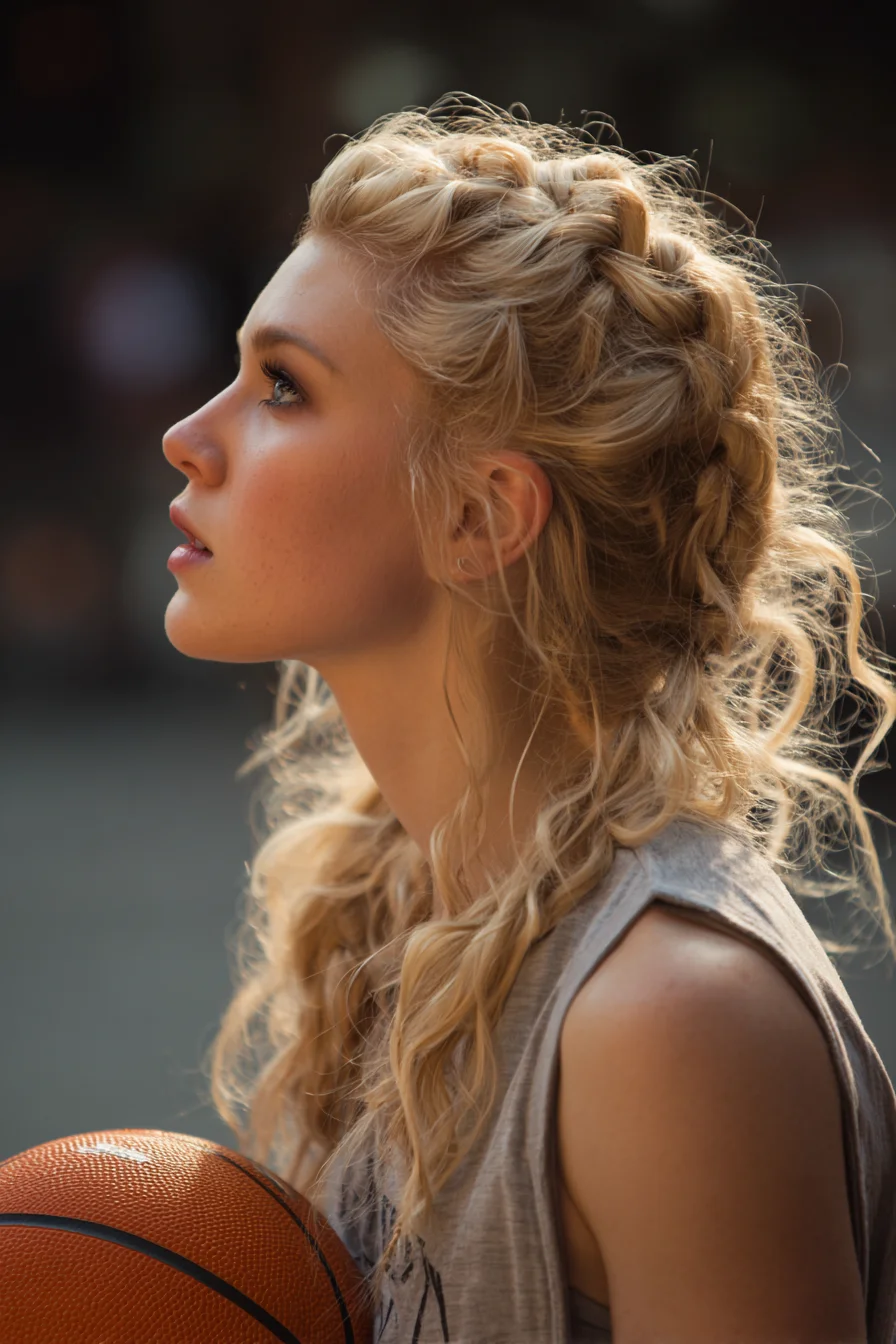
Hi, I’m Lena, a professional hairstylist with over a decade in busy salons. In this post I share 24 easy basketball hairstyles for women — quick, secure, and stylish looks that hold up through practice, games, and hot gym sessions. I’ll cover low-maintenance options like high and low ponytails, sporty buns, braided wraps, cornrows, half-up styles, and protective looks using headbands and elastic-friendly techniques. These styles suit athletes, coaches, students, and anyone who wants neat hair that stays put under a helmet or while sprinting. I’ll include step-by-step tips for hair prep, the best products (light-hold gels, silicone-free serums, strong grips), and quick modifications for different hair lengths and textures. Expect practical salon-tested tricks for lasting hold, clean edges, and how to refresh hair between quarters — all demonstrated across 24 helpful images.
Textured Crown Dutch Braid (Pancaked) into Low Braided Ponytail
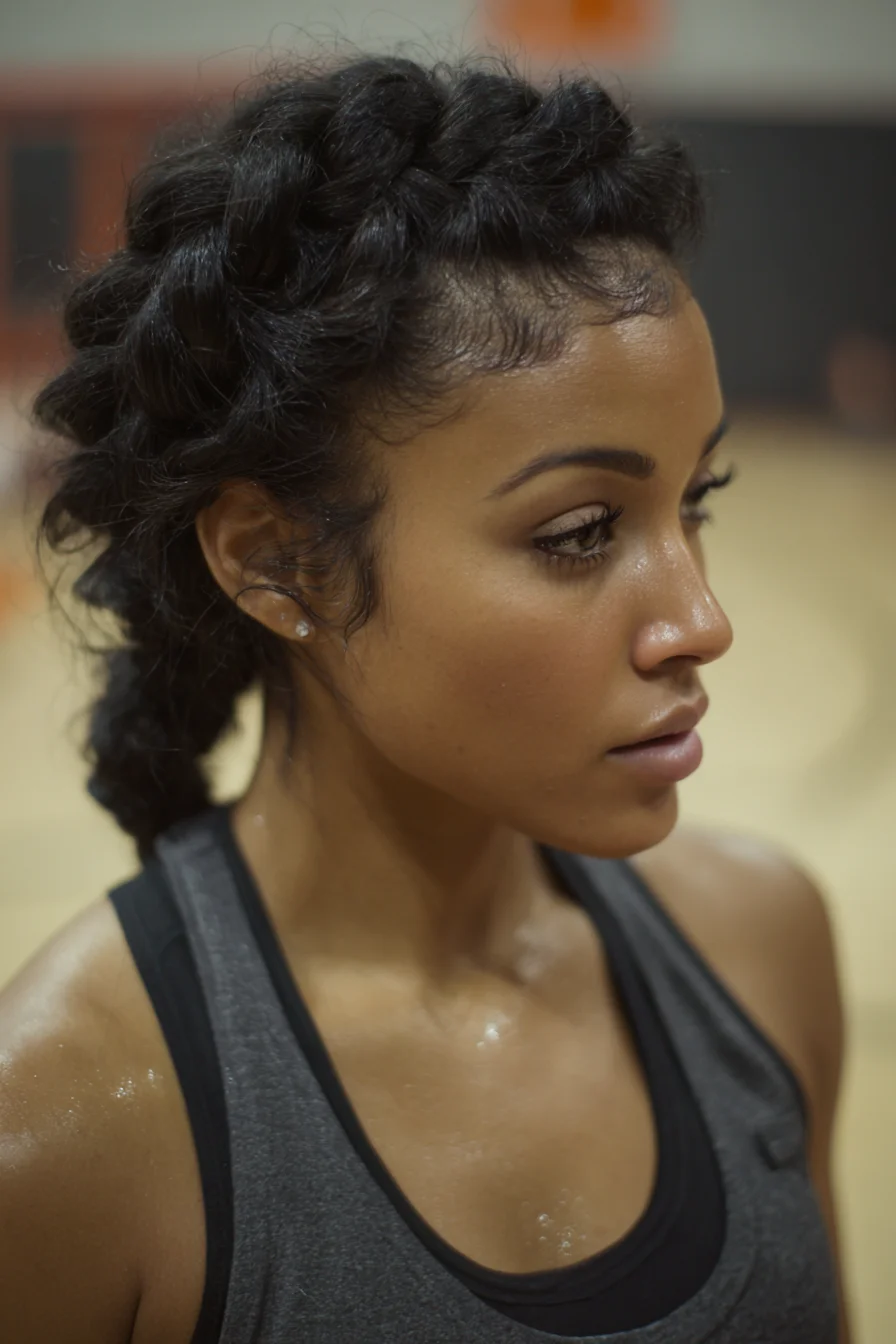
This look is a salon-friendly crown Dutch braid that transitions into a low braided ponytail—ideal for medium to thick textures and Type 3–4 natural curls, but adaptable to straight hair when pre-texturized. Start on damp, detangled hair: apply a lightweight leave-in conditioner and a small amount of styling cream to reduce frizz. Section at the hairline and create a Dutch (inside-out) braid along the crown, incorporating hair as you move toward the nape. Pancake (gently tug) the braid for width and softness, then gather the remaining hair into a low pony and finish with a three-strand or rope braid. Tools: wide-tooth comb, rat-tail comb, hair clips, small elastic bands and bobby pins, blow-dryer with diffuser (optional). Products: leave-in, smoothing cream or light gel, edge control for baby hairs, lightweight oil for shine, and flexible-hold hairspray. Difficulty: moderate — requires comfortable braiding and sectioning skills. Maintenance: sleep on a satin scarf/bonnet, refresh edges with water and edge control, lightly mist and reapply oil to ends, and expect to refresh or redo after 5–7 days to prevent buildup and maintain shape.
Cornrows Into Curly Braided Ponytail — Sporty Protective Style
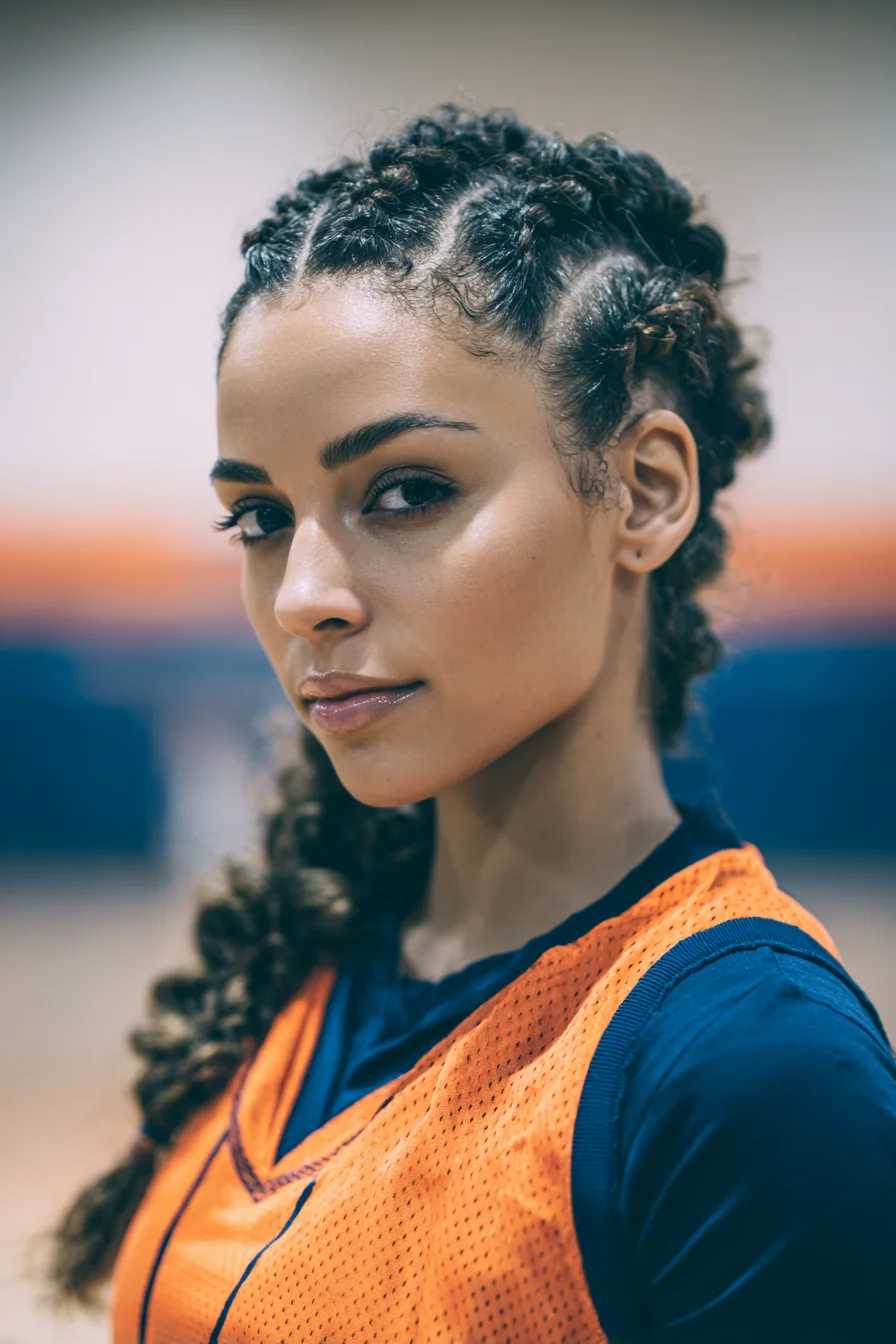
This polished look pairs neat cornrows at the top with a long curly braided ponytail — ideal as a protective, athletic hairstyle. Best suited for medium to thick textured hair (Type 3–4) and blended or chemically relaxed hair with added texture; finer or very straight hair can achieve the style with light texturizing product or clip-in extensions. Technique: section defined rows with a rat-tail comb, apply a leave-in moisturizer, then feed-in or three-strand cornrow each section toward the crown; gather the ends and finish as a rope or three-strand braid leaving the tail curled or fanned. Tools needed: rat-tail comb, sectioning clips, small elastic bands, edge brush, fine-tooth comb. Products required: lightweight leave-in conditioner, styling gel or braid wax for hold, edge control, light hairspray, and a finishing oil or shine spray. Difficulty: moderate — requires basic braiding skill and clean parting; allow 45–75 minutes. Maintenance tips: sleep with a silk scarf or bonnet, refresh edges and scalp with a water-based spray and light oil, avoid over-tightening to protect the hairline, and redo after 2–4 weeks or as growth dictates.
Halo Flat-Twist Crown Updo for Natural Curly Hair
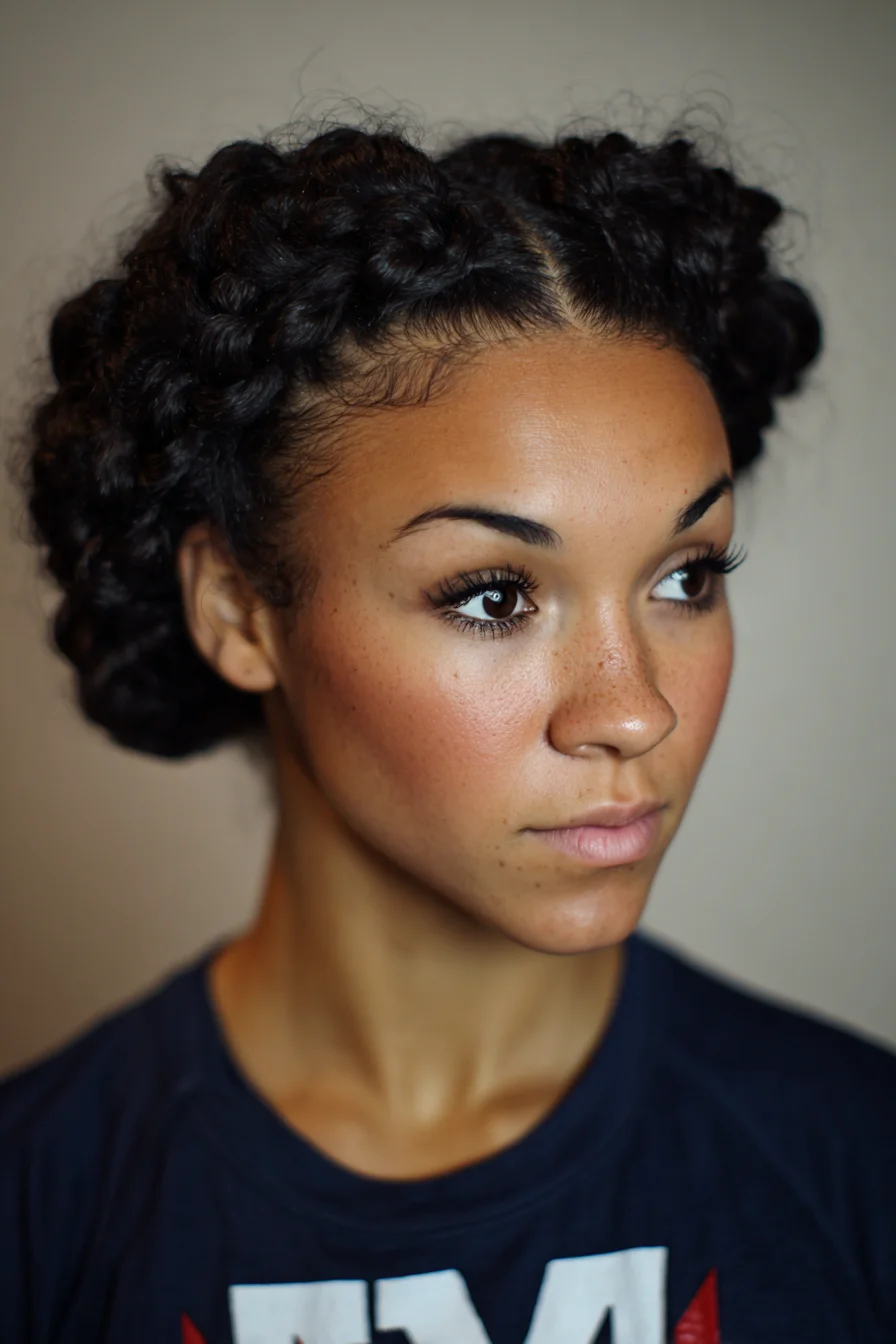
This halo flat-twist crown is ideal for 3A–4C textured hair and medium to high density. It works best on stretched or damp hair to keep twists smooth without sacrificing curl definition. Technique: detangle and apply a leave‑in conditioner, then a curl cream or light gel for hold. Create a clean center part, section hair into two halves and perform two flat (two‑strand) twists along the hairline toward the back, rolling each twist into the crown and securing with bobby pins. Tools needed: rat‑tail comb, sectioning clips, wide‑tooth comb or Denman for detangling, bobby pins, small elastics, and a spray bottle. Products required: leave‑in conditioner, curl cream or medium‑hold gel, edge control or pomade for baby hairs, and a lightweight oil or serum to seal. Difficulty: intermediate — basic twisting skill and neat parting are required; expect a 30–60 minute salon timing. Maintenance: sleep on a satin bonnet or pillowcase, refresh with a light water and leave‑in mist, re‑pin loose sections, and avoid heavy buildup by clarifying weekly. Keep tension gentle to protect the hairline.
High Curly Puff Bun with Headband — Voluminous Defined Curls
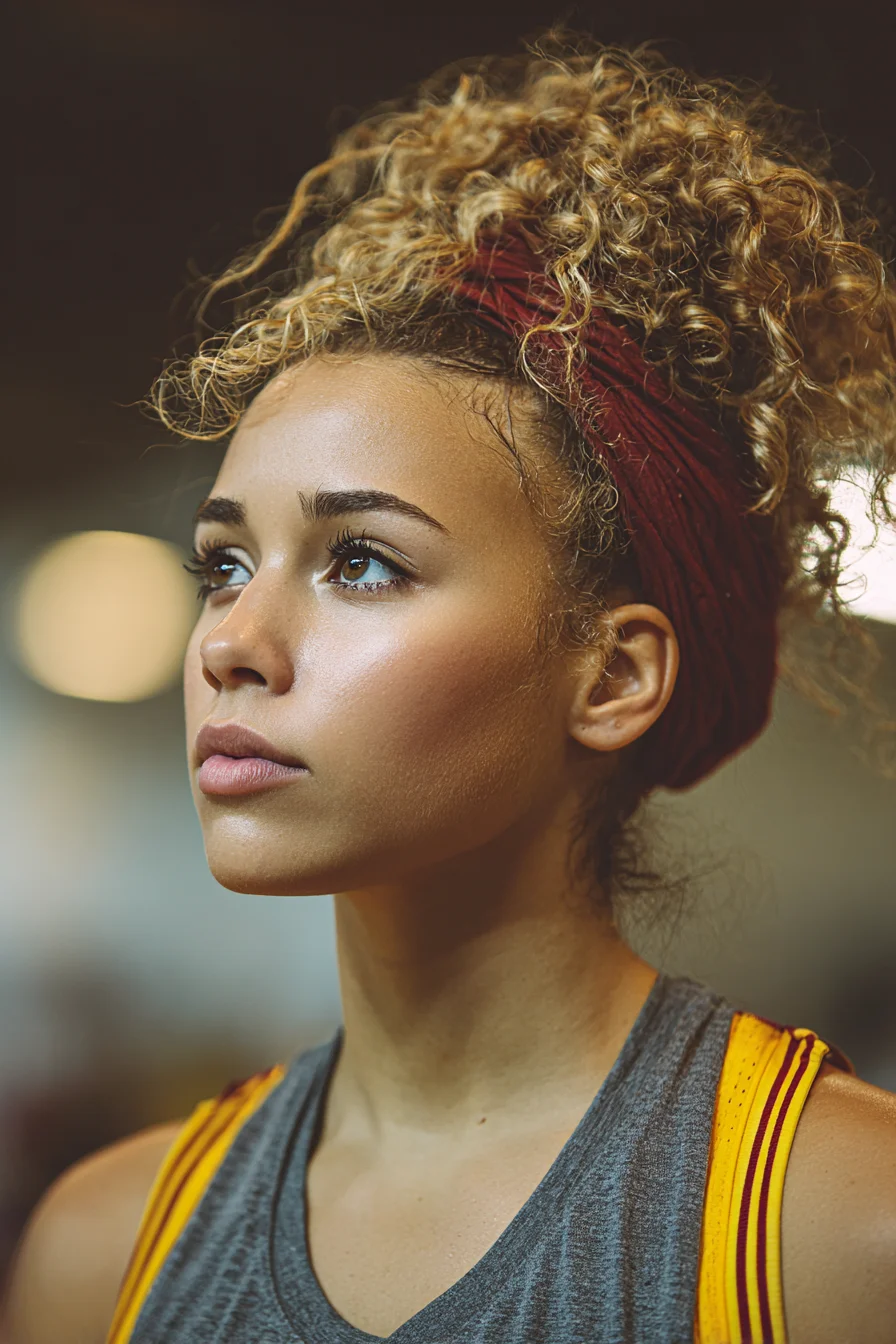
Perfect for 3A–4B curls and wavy hair in medium to long lengths, this high curly puff bun with a fabric headband offers instant volume while keeping curl definition. To style: work on damp, detangled hair treated with a leave‑in conditioner, then apply a curl cream or light gel through mid‑lengths and ends. Gather hair high at the crown using your fingers to preserve the natural pattern, secure with a snag‑free elastic or scrunchie, and gently pull out outer curls to create a rounded, airy silhouette. Wrap a wide fabric headband or scarf around the base to hide the elastic and add polish; insert a few bobby pins for extra hold. Tools: wide‑tooth comb, detangling brush, microfiber towel, diffuser (optional), bobby pins, soft elastic/scrunchie. Products: leave‑in conditioner, curl cream or light gel, lightweight oil or serum for shine, edge control for baby hairs, flexible hairspray. Difficulty: easy–intermediate — quick once you learn tension and placement. Maintenance: refresh with water or curl refresher spray and finger‑reshape, pineapple at night or use a satin bonnet, and deep‑condition weekly to maintain moisture and bounce.
Double Dutch (Boxer) Braids — Textured Two-Braid Sport Hairstyle
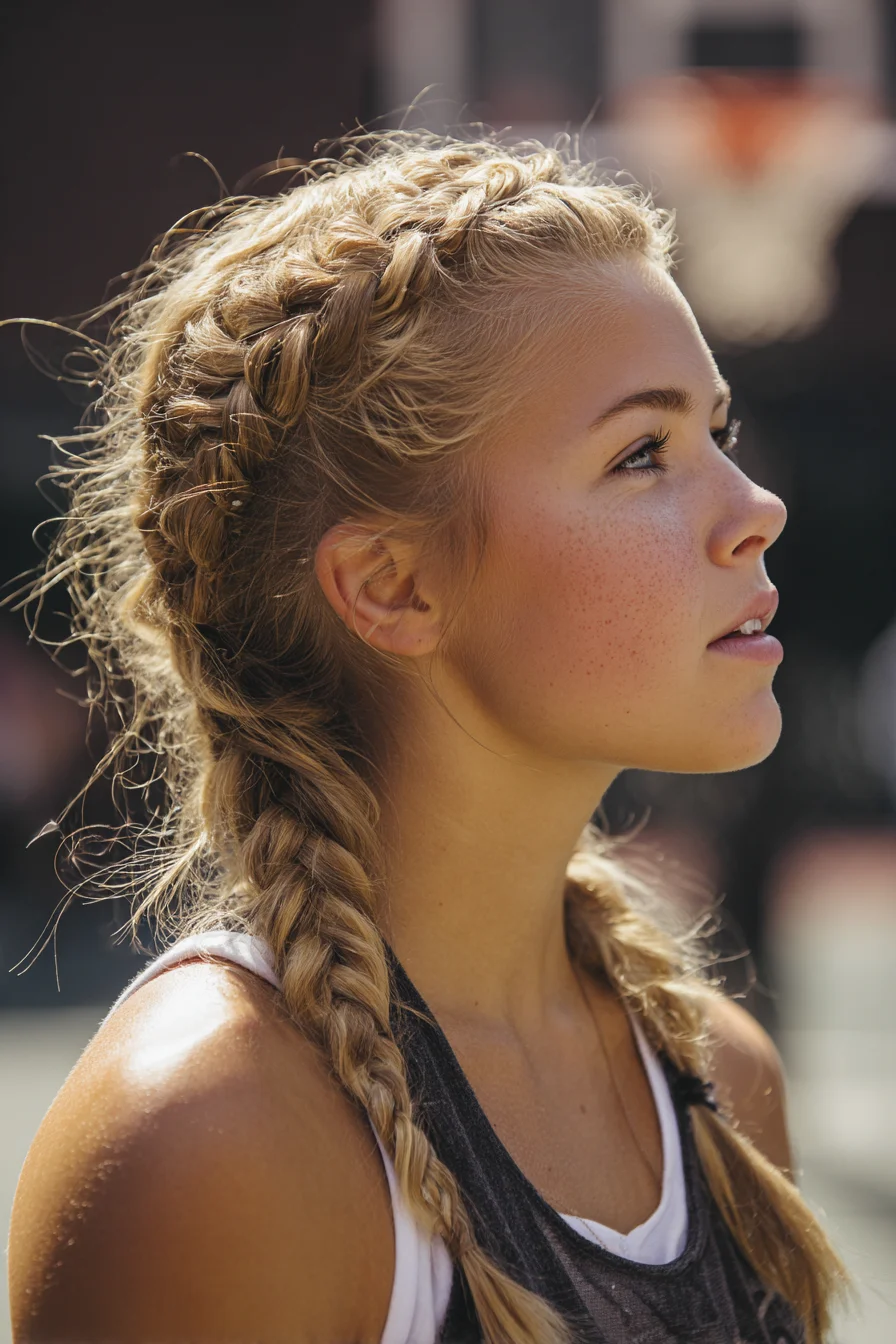
These double Dutch (boxer) braids are a versatile, textured style that works well for active days or an elevated casual look. Suitability: best for medium to long hair and medium to thick densities; fine hair benefits from texturizing powder or lightweight extensions, while curly hair should be detangled and smoothed with a leave-in. Technique: create a clean center part, section one side and begin an underhand (Dutch) braid at the hairline, adding hair as you move toward the nape; finish both sides into three-strand braids and secure with elastics. Tools needed: rat-tail comb, sectioning clips, small clear elastics, boar-bristle or paddle brush. Products required: lightweight gel or mousse for grip at the roots, leave-in conditioner, texturizing spray or powder for hold and volume, and a flexible-hold hairspray to set. Difficulty level: intermediate — takes practice to keep even tension, 20–45 minutes depending on skill. Maintenance tips: sleep with a silk scarf, refresh with dry shampoo and texturizer, re-tighten or re-braid after 2–3 days, and avoid overwashing to preserve style grip.
Double Dutch Braids Gathered into a Low Textured Bun — For Wavy to Thick Hair
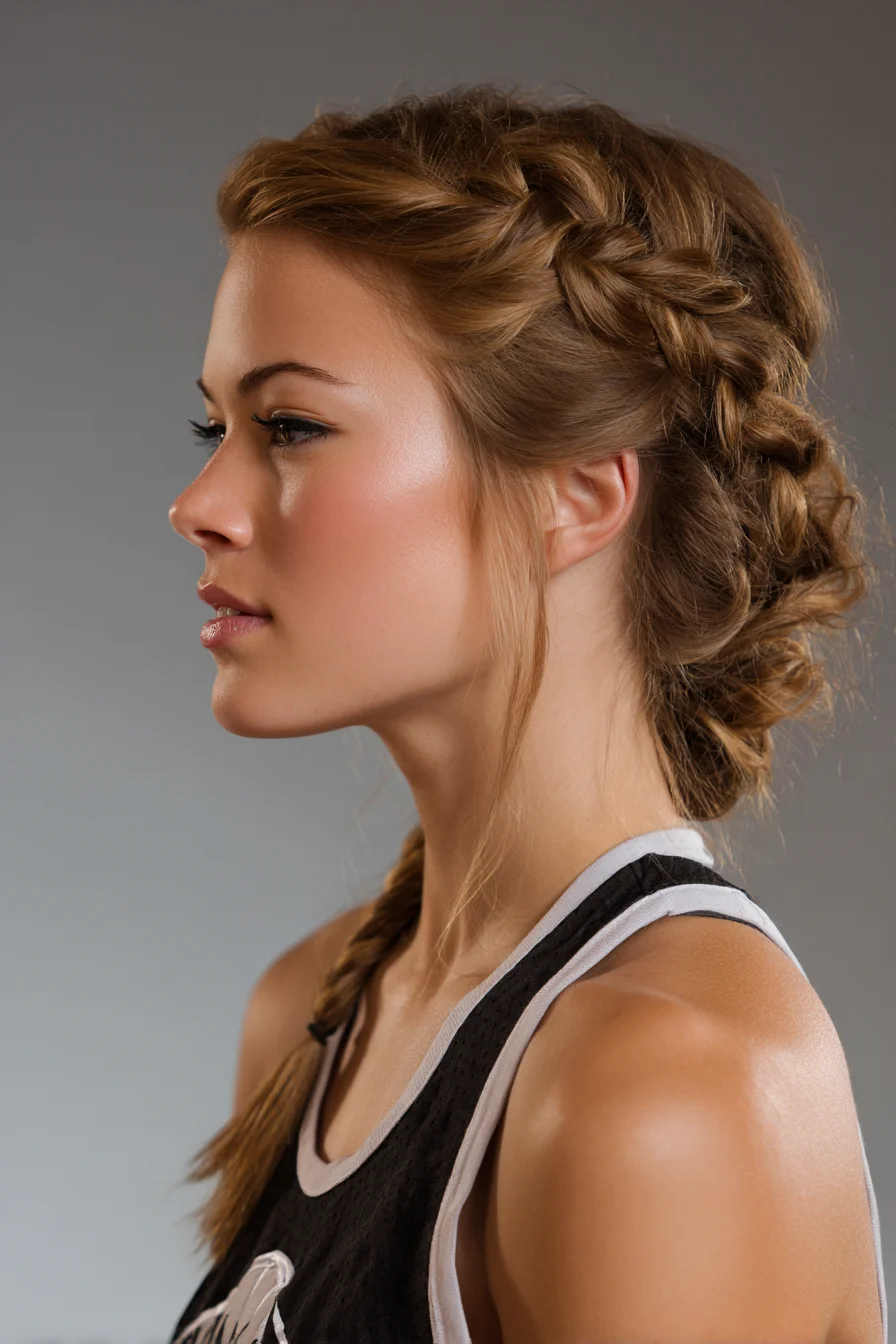
This look suits medium to long hair with straight, wavy or slightly curly textures and benefits from medium-to-thick density for fullness. Start on dry, day-two hair: apply a light texturizing or sea-salt spray for grip, then create a clean side part and begin two Dutch (reverse French) braids at the hairline, adding hair as you work toward the nape. Join the braid ends and wrap them into a loose, low braided bun, securing with elastics and bobby pins. Gently pancake the braids for volume and pull a few face-framing pieces free for softness. Tools needed: fine-tooth comb, tail comb, small elastics, bobby pins, sectioning clips. Products required: texturizing spray, light-hold hairspray, smoothing serum or cream for flyaways, and optional dry shampoo for extra hold. Difficulty: intermediate — requires braiding practice and even tension. Maintenance tips: refresh texture with dry shampoo and a spritz of salt spray, retuck or repin loose sections, protect at night with a silk scarf, and trim ends regularly to keep braids neat and avoid excess frizz.
Textured Double Dutch Braids — Messy Pigtail Braids
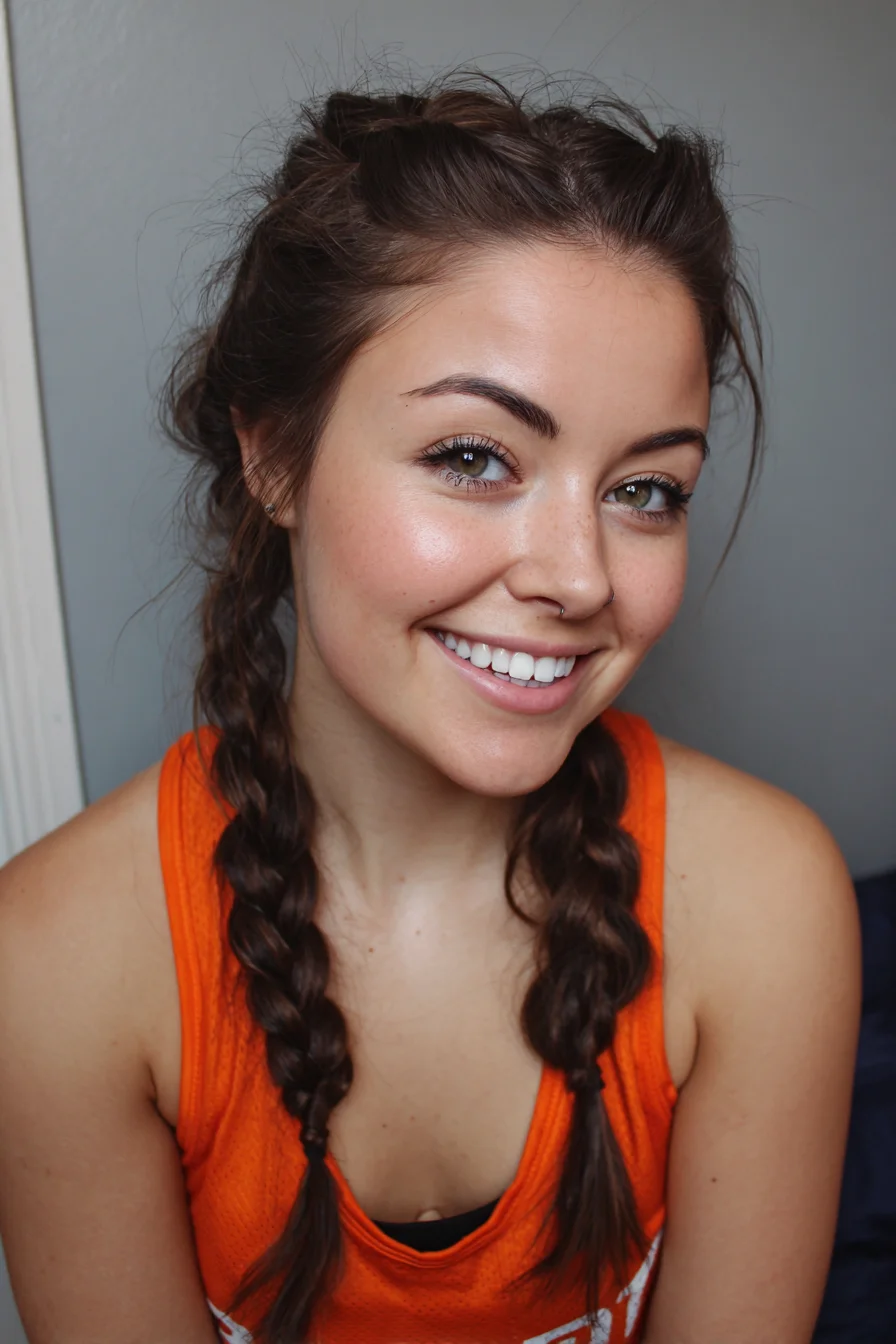
A salon‑friendly take on classic pigtail braids, these textured double Dutch braids work well on straight, wavy and loose curly hair and are particularly flattering on medium to thick hair. For fine hair, pre‑texturizing or light backcombing at the crown adds grip and volume. Technique: start with a clean center part, apply texturizing spray, then create two Dutch braids by crossing outer sections under the middle and adding hair as you move down from the hairline to the nape. Braid to the ends, secure with small elastics and gently pancake the braid loops for fullness and a lived‑in look. Tools needed: rat‑tail comb, paddle brush, sectioning clips, small clear elastics, bobby pins. Recommended products: sea‑salt or dry‑texturizing spray, light hold hairspray, smoothing serum for flyaways, and dry shampoo for extra grip on second‑day hair. Difficulty: easy–moderate; basic braiding skills required. Maintenance tips: sleep on a silk pillowcase or wrap with a scarf, refresh with dry shampoo and a quick re‑pancake each morning, and redo braids after 2–3 days to prevent breakage and loosened sections.
Textured Side Dutch Braid into Low Braided Bun — Romantic Updo
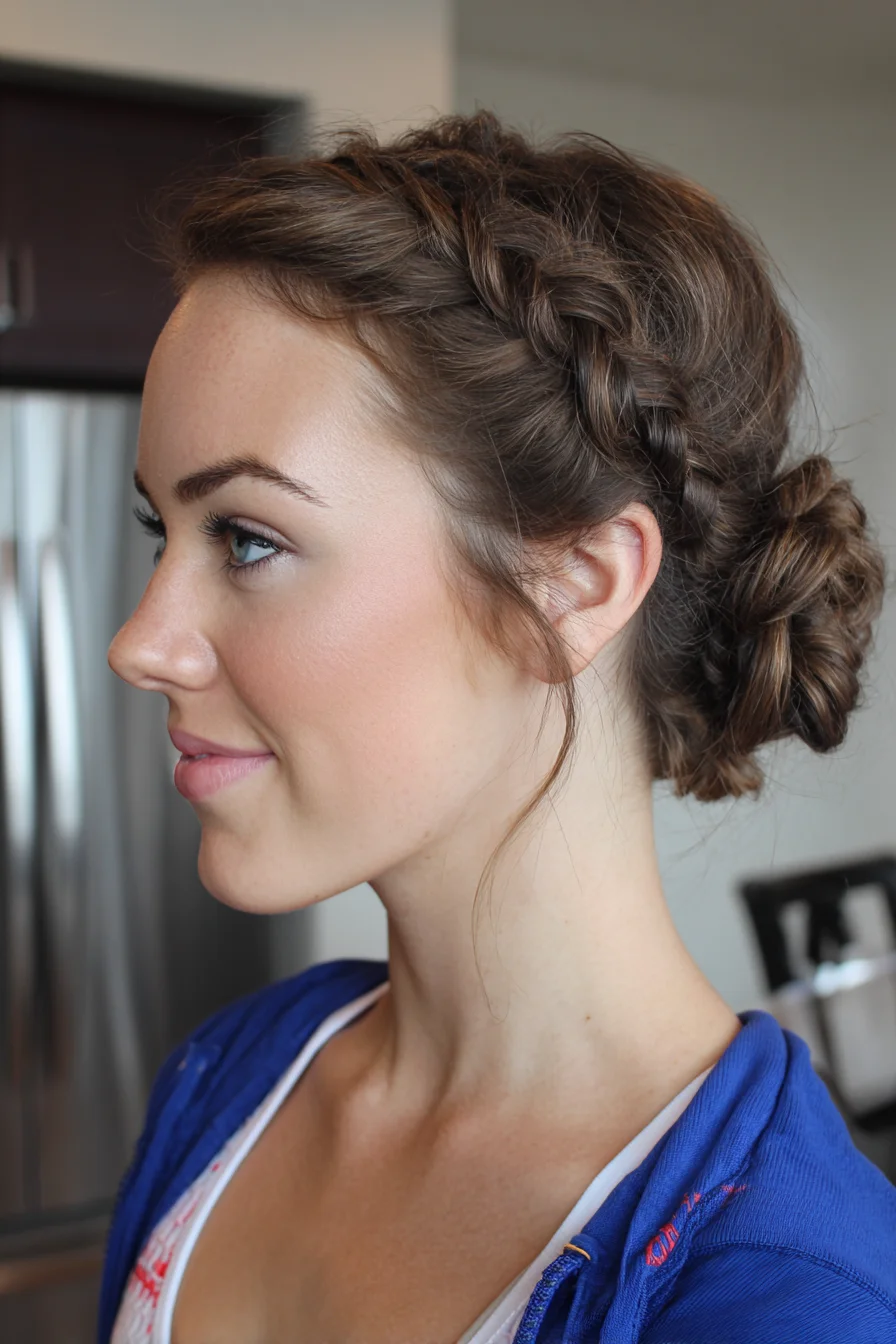
This soft, textured side Dutch braid flowing into a low braided bun suits medium to long hair and works best on medium to thick textures or natural waves. Fine hair can achieve the same look by pre-adding texture with dry shampoo or a light volumizing powder. Technique: start by parting to the side and create a Dutch (reverse) braid along the hairline toward the nape, gently pancake each stitch for width, then gather remaining hair into a low twisted or braided bun and secure with elastics and pins. Tools needed: tail comb, sectioning clips, small clear elastics, bobby pins, and optionally a small hair donut for extra shape. Recommended products: texturizing spray or sea-salt mist for grip, lightweight styling cream or serum for flyaways, heat protectant if you pre- curl, and a medium-hold hairspray to lock the style. Difficulty level: intermediate — requires basic braiding and pinning skills. Maintenance tips: refresh grip with dry shampoo, re-pin loose pieces, sleep with a silk scarf to protect shape, and touch up face-framing tendrils with a tiny bit of styling cream.
Double Dutch Braids with Top-Knot Accents — Textured Sporty Braids
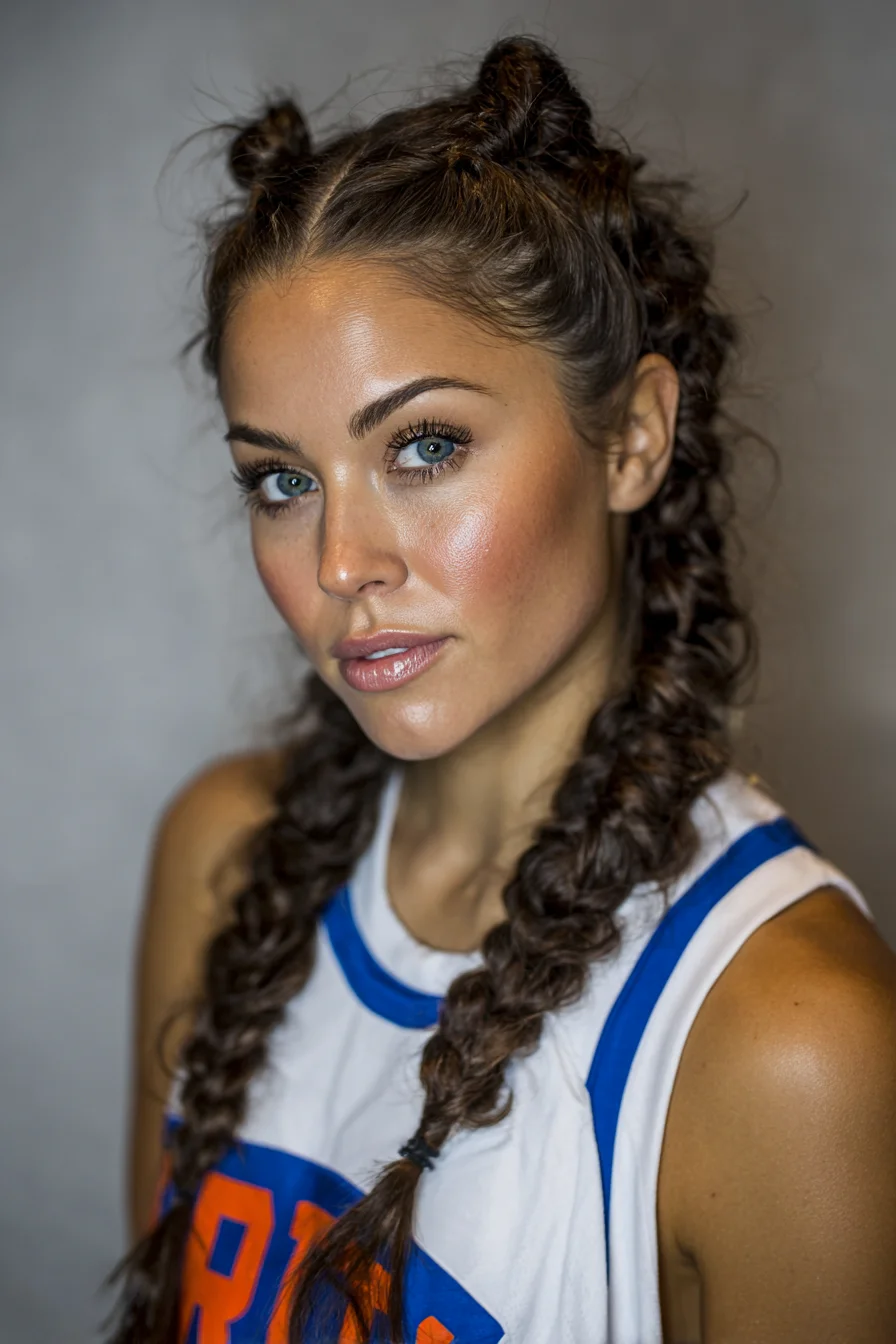
Suitable for medium to thick hair and straight to wavy or loosely curly textures; fine hair can work with added extensions or texturizing products. To create: start on dry—or slightly damp—hair with a clean center part. Section two front-to-nape panels and build Dutch (inside-out) braids along the scalp to the nape, incorporating hair as you go. Secure ends with small elastics and create two mini top knots by twisting and wrapping the crown sections, pinning with bobby pins. Loosen or ‘pancake’ the braid sections with your fingers to create width and texture. Tools: rat-tail comb, sectioning clips, elastic bands, long bobby pins, small toothbrush for baby hairs. Products: salt or texturizing spray for grip, light-hold gel or pomade for smooth edges, lightweight hairspray and a shine serum. Difficulty: intermediate — expect 20–45 minutes depending on length and thickness. Maintenance: sleep on a silk pillow or wrap with a silk scarf, refresh with dry shampoo and a quick mist of texturizer, re-tighten elastics after 2–3 nights. For curly hair, braid damp to reduce frizz and dry fully to set the shape.
Double Dutch Braids into Textured Ponytail Braids
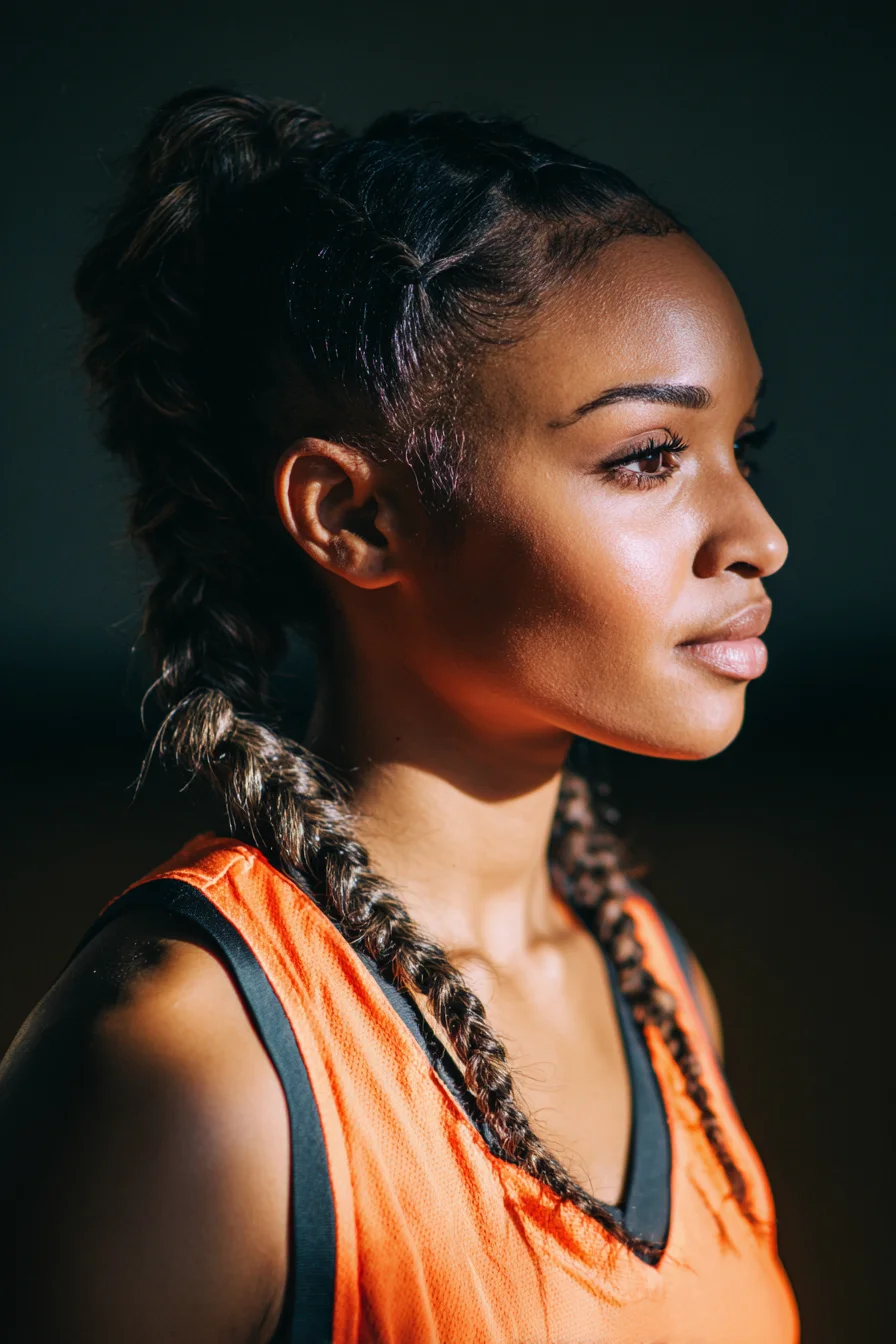
This polished double Dutch braid style finishes into textured ponytail braids — a versatile, sporty look suited to everyday wear. Best for medium to thick hair and natural curl patterns (2–4), it also translates well to fine or straight hair when pre-textured with a spray. Technique: create a clean center part, then Dutch-braid each side tightly from the hairline to the nape, secure into high ponytails and continue into three-strand or rope braids. Lightly pancake the braids by pulling outer strands to widen them for the chunky, textured finish. Tools needed: rat-tail comb, sectioning clips, boar-bristle brush, small clear elastics, tail comb and optional flat iron for smoothing edges. Products required: leave-in conditioner, a medium-hold styling cream or pomade for grip, edge control gel, texturizing spray and a light-hold hairspray or shine serum. Difficulty level: intermediate — requires braiding skill and neat parting but is attainable at home with practice. Maintenance tips: sleep in a silk scarf or bonnet, refresh with water + leave-in or light mousse to revive texture, reapply edge control as needed, and redo within 1–2 weeks to prevent tension and buildup.
Textured Double Dutch (Boxer) Braids for Medium–Long Platinum Blonde Hair
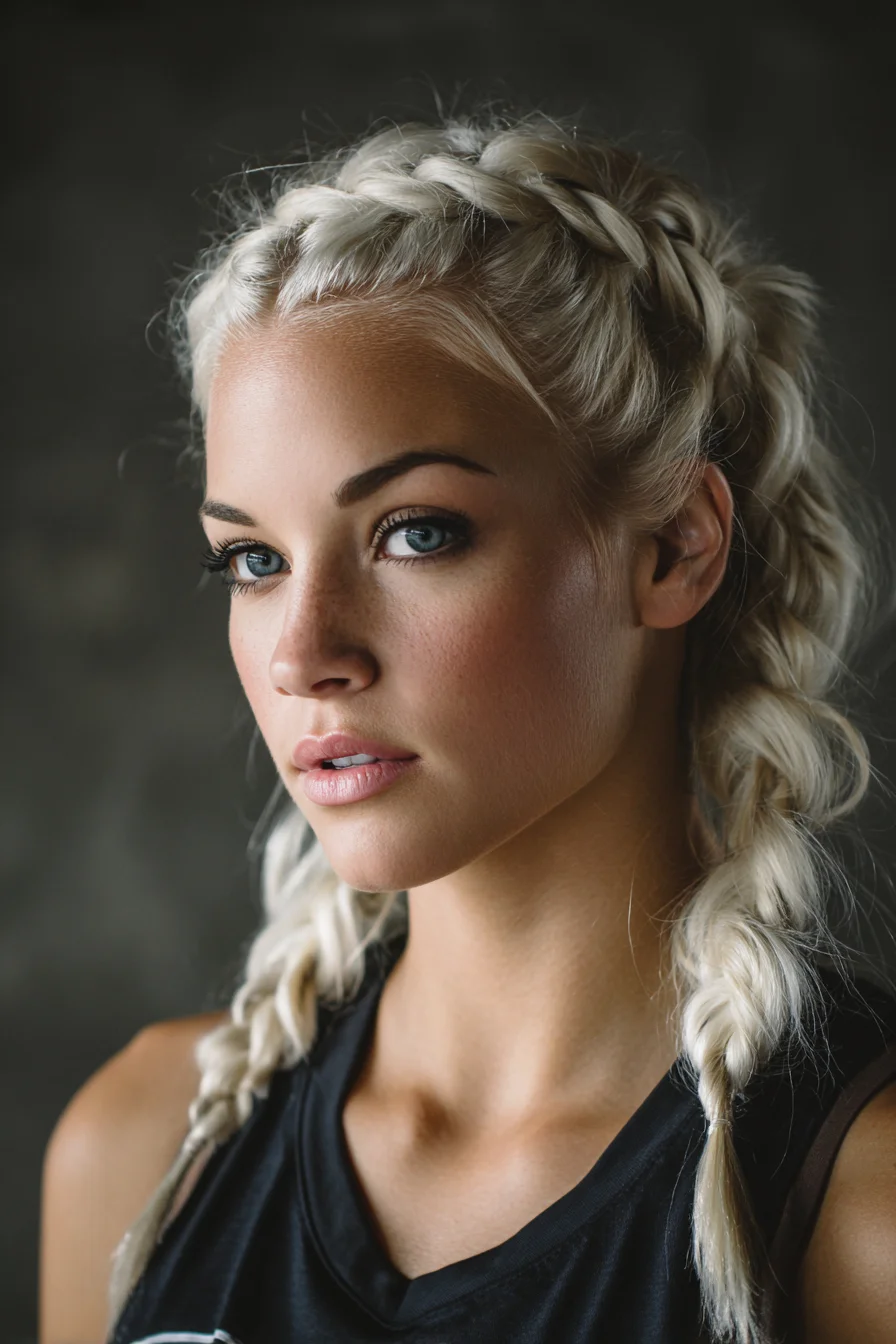
These mirrored Dutch (boxer) braids create a textured, lifted look ideal for medium-to-long hair. Suitable for fine to thick hair, the style works best on lengths that reach at least mid-shoulder; curly or highly textured hair can be smoothed with a leave-in or braided in its natural state for a softer finish. Technique: create a clean center part, section at the hairline and begin a tight Dutch braid (cross under) adding hair as you move toward the nape. Continue each braid to ends and secure with small elastic. Loosen the braid by gently pancaking the sides to create fullness and an effortless finish. Tools: tail comb, sectioning clips, hair elastics, paddle brush, optional flat iron or curling wand for polished ends. Products: lightweight texturizing spray or dry shampoo for grip, smoothing cream for flyaways, light-hold hairspray and a reparative mask for bleached hair. Difficulty: intermediate — requires comfortable underhand braiding and even tension. Maintenance: sleep with a silk wrap, refresh roots with dry shampoo, re-pancake or tighten braids every 1–2 days, and deep-condition weekly if hair is color-treated.
Boho Double Fishtail Braids with Crown Twist — Textured Long Hair
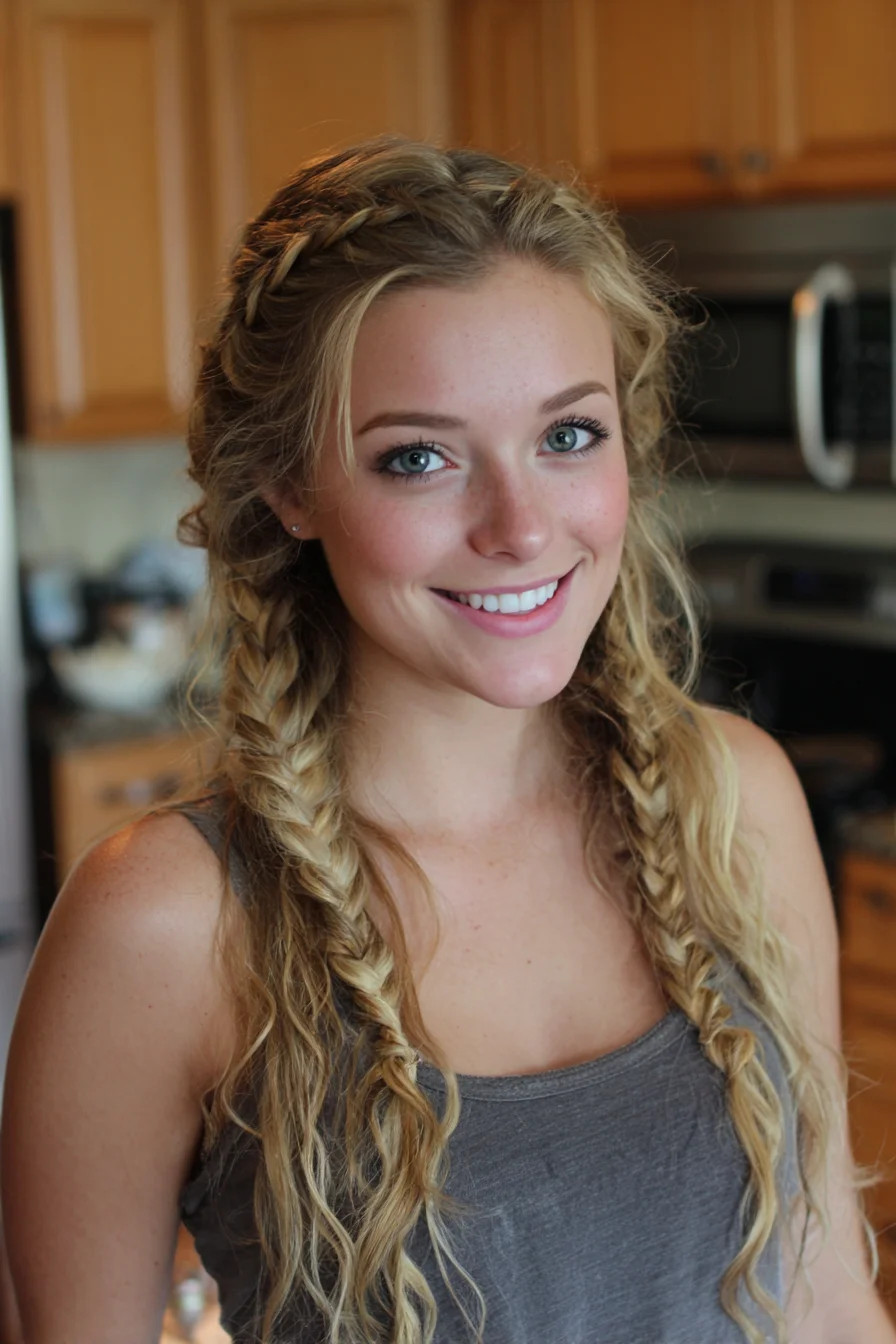
A relaxed boho style featuring two loose fishtail braids with a small crown twist along the hairline. Best suited to medium-to-long lengths and naturally wavy or textured hair; fine hair will benefit from texturizing for extra grip while thick hair gives fuller-looking braids. Technique: create a center or slightly off-center part, mist roots and lengths with a sea-salt or texture spray, then bring two front sections from the temples and fishtail-braid each down to the ends. Add a small twisted section over the crown and secure with bobby pins, then pancake the braids by gently tugging outer strands to widen and soften the look. Tools needed: tail comb, small clear elastics, bobby pins, sectioning clips and an optional curling wand for shaping ends. Products required: sea-salt or texturizing spray, dry shampoo for grip, light-hold hairspray and a small amount of smoothing serum for flyaways. Difficulty: intermediate — requires practice with the fishtail technique and shaping. Maintenance tips: sleep with a silk scarf or loose braid, refresh with dry shampoo or a mist of salt spray, and re-pancake braids each morning to revive volume.
Textured Dutch Braid into Messy Ponytail — Braided Updo for Curly/Wavy Hair
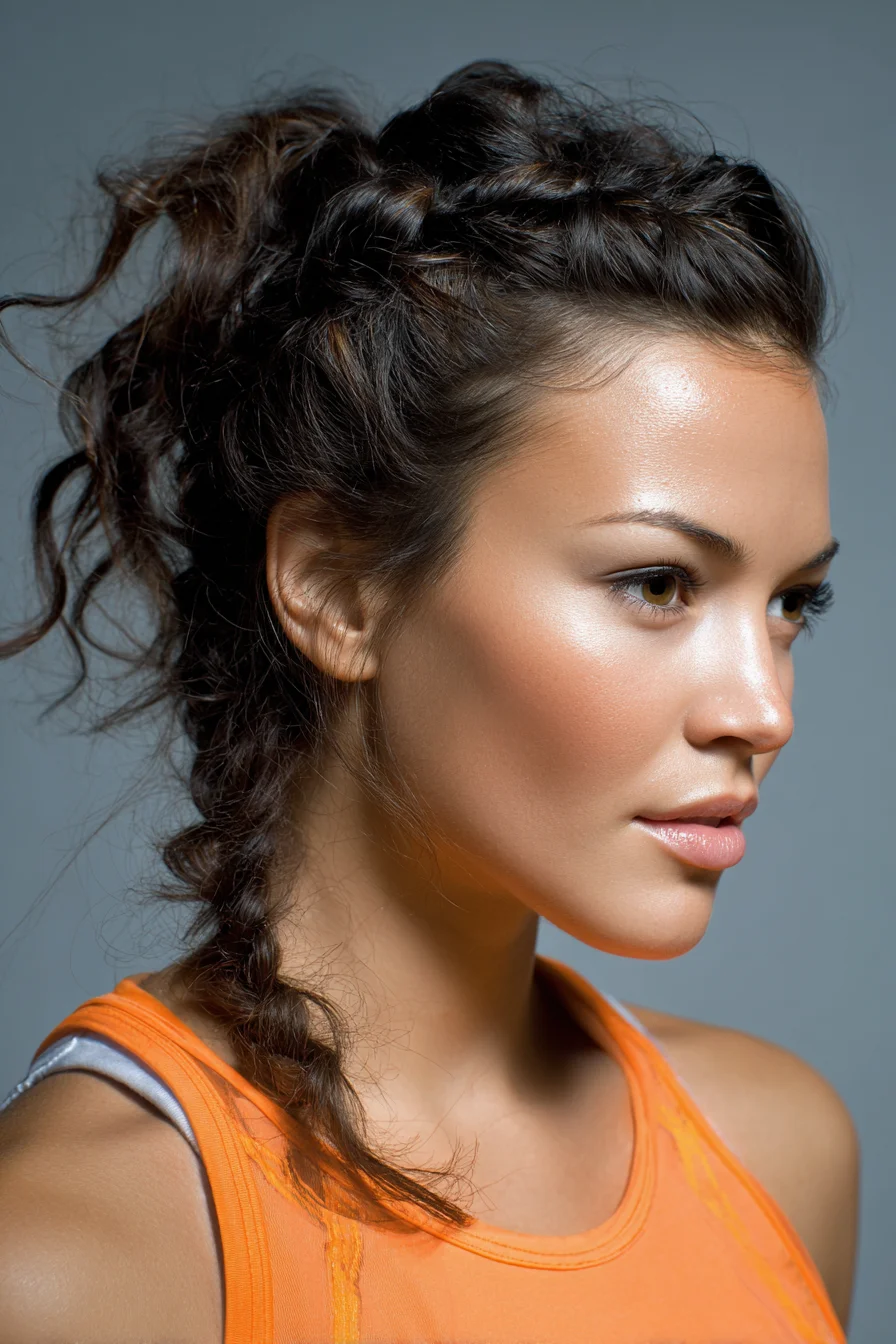
This look works best on wavy to curly hair and medium to thick textures — it uses natural volume and texture for a relaxed, salon-finished braided updo. Technique: create a deep Dutch (inside-out French) braid starting at the hairline and work toward the crown, securing the braid at the nape; continue as a loose braid or gather into a messy low ponytail. Gently pancake the braid (pull outer loops) to widen it and pull a few face-framing pieces for softness. Tools needed: rat-tail comb, sectioning clips, small elastic bands, bobby pins, and an optional curling iron or diffuser for shaping ends. Recommended products: sea-salt or texturizing spray for grip, light hold hairspray, smoothing serum for flyaways, heat protectant if using hot tools, and dry shampoo to refresh. Difficulty: moderate — requires basic braiding skill and patience for pancaking. Maintenance tips: sleep on a silk pillow or loosely pineapple the braid, refresh with dry shampoo and re-tighten or re-pin sections as needed, and reshape ends with a curling iron between washes. Avoid heavy conditioners at the root to preserve texture.
Double Dutch Braids with Textured Fishtail Ends
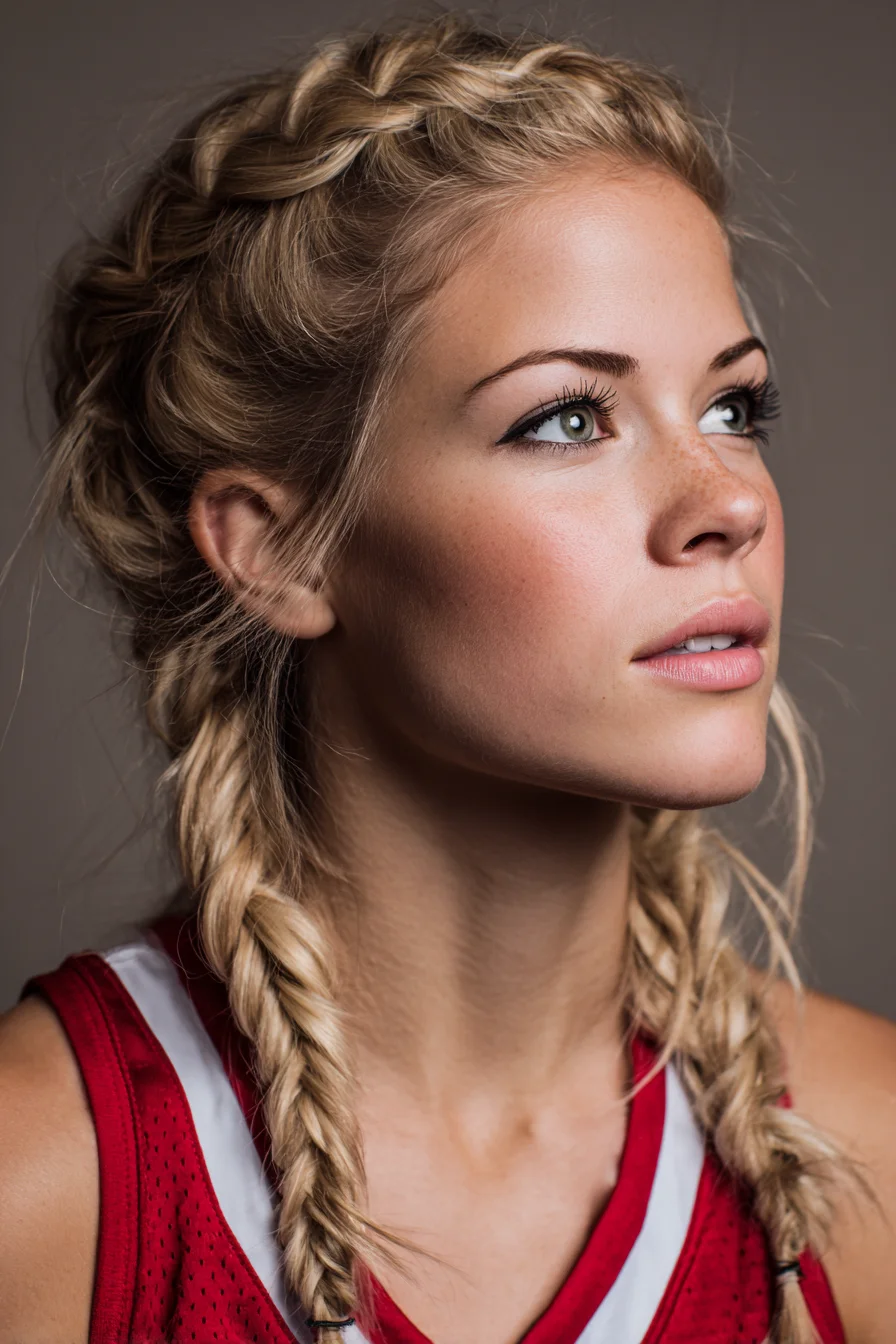
This sporty-chic style combines two Dutch (inside-out) braids started at the hairline that transition into slightly undone fishtail finishes — ideal for active days or casual events. Best suited to medium-to-thick hair and straight-to-wavy textures; fine hair can achieve similar volume with a texturizing spray and light backcombing at the roots. Technique: create a clean center part, section hair into two panels, Dutch-braid each panel from the hairline to nape, then switch to fishtail (or three-strand) braiding for the remaining length. Gently pancake the braids by pulling outer loops to soften and add fullness. Tools needed: rat-tail comb, small sectioning clips, elastic bands, fine-tooth brush, and a wide-tooth comb. Products required: texturizing or sea-salt spray for grip, lightweight smoothing serum for flyaways, and a flexible-hold hairspray to set. Difficulty level: intermediate — expect 20–40 minutes depending on practice. Maintenance tips: refresh with dry shampoo for grip, re-tighten elastics after sleeping or workouts, wrap with a silk scarf to reduce frizz, and reapply lightweight oil to ends every few days to prevent dryness.
Double Dutch Boxer Braids — Sleek Center-Part Braids for Medium to Thick Hair
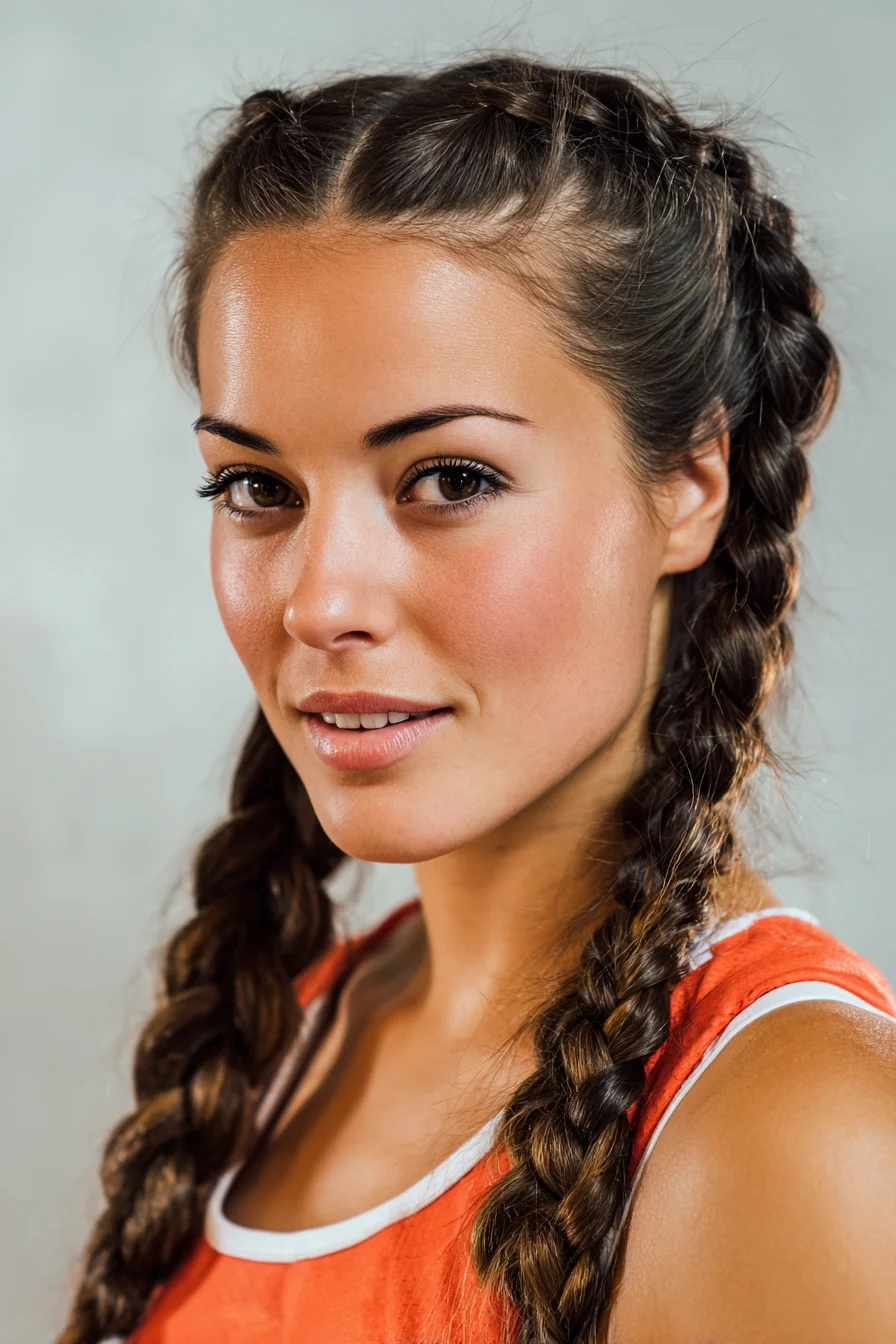
These are double Dutch (boxer) braids styled on a clean center part — ideal for medium to thick and textured hair; fine hair can wear the look with added texture or small extensions. Technique: start with a clean, slightly damp blow-dried or air-dried base and create a precise center part. Section one side, smooth with a tail comb, and begin a Dutch (underhand) three-strand braid close to the scalp, adding small sections as you move toward the nape; repeat on the opposite side. Continue into regular three-strand braids and secure with elastics. Loosen (pancake) the braids gently for fullness if desired. Tools: tail comb, detangling brush, sectioning clips, small clear elastics, bobby pins. Products: lightweight smoothing cream or leave-in conditioner, texturizing spray or dry shampoo for grip, light-hold hairspray, and a serum for ends. Difficulty: moderate — 20–45 minutes depending on skill and hair length; practice improves speed and symmetry. Maintenance: sleep on a silk pillowcase or wrap with a silk scarf, refresh with dry shampoo and edge control, avoid excessive tension to protect the hairline, and deep-condition weekly when worn frequently.
Loose Double Dutch Braids with Soft Face‑Framing Pieces
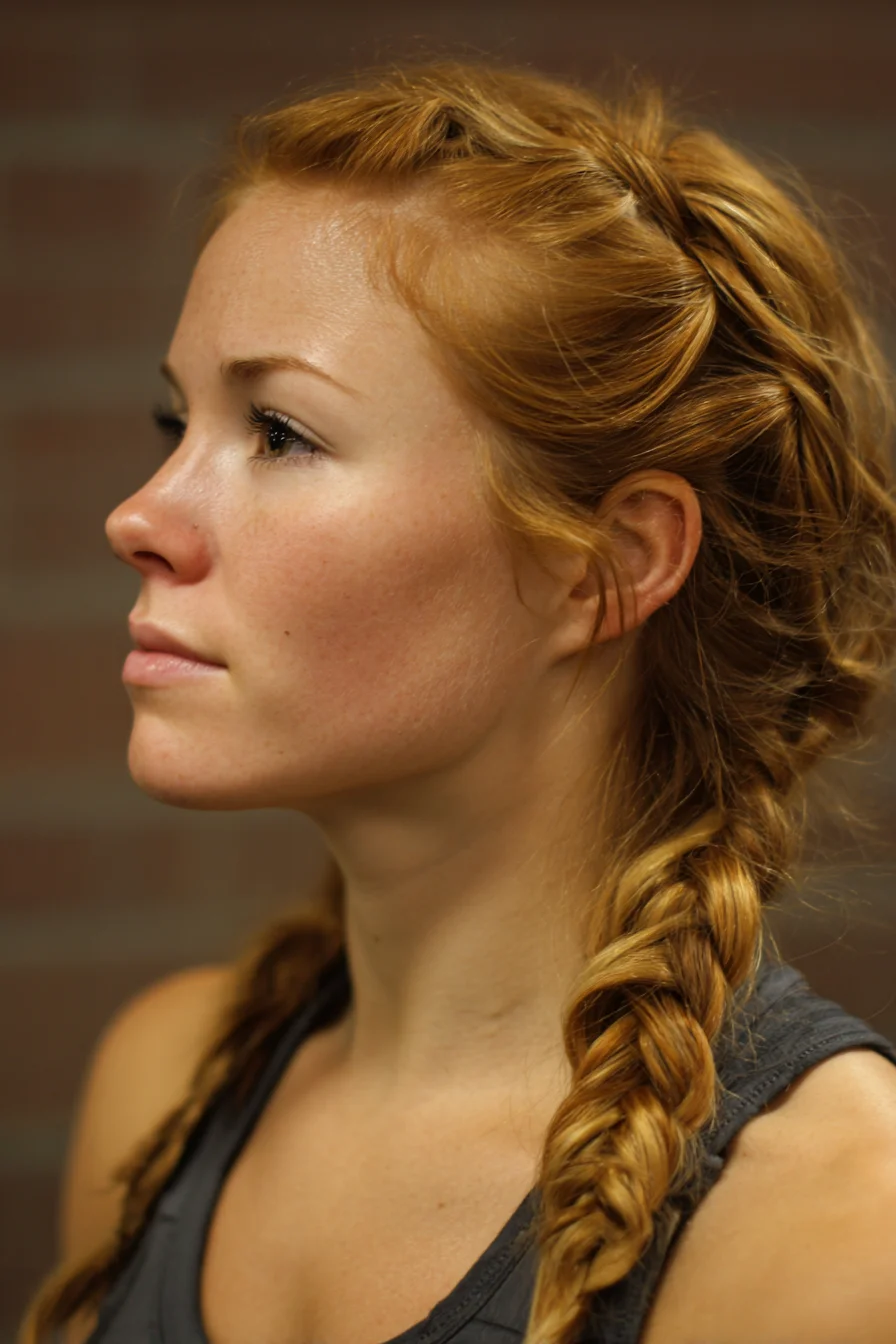
This textured double Dutch braid suits medium‑to‑long hair and works well on straight, wavy or slightly curly textures. For fine hair, add a texturizing spray or light mousse for grip; thick hair benefits from sectioning and a little smoothing cream to control bulk. Technique: create a clean center part, take three small sections at the hairline and braid under (Dutch method), adding hair as you move down each side. Finish with elastics and pancake the braid by gently pulling outer loops for width and softness. Tools: tail comb for parting, sectioning clips, small clear elastics, boar‑bristle brush, and a few bobby pins for stray pieces. Products: sea‑salt or texturizing spray for hold, light smoothing cream or cream pomade for frizz control, dry shampoo to add texture at the roots, and a flexible‑hold hairspray to set. Difficulty: moderate — a stylist can complete it in 15–25 minutes; DIY may take 25–40 minutes depending on braiding skill. Maintenance: sleep on a silk pillowcase or loosely wrap braids, refresh with dry shampoo and re‑pancake as needed, and avoid overtightening to protect the hairline.
Textured Crown Braid with Wispy Face-Framing Waves
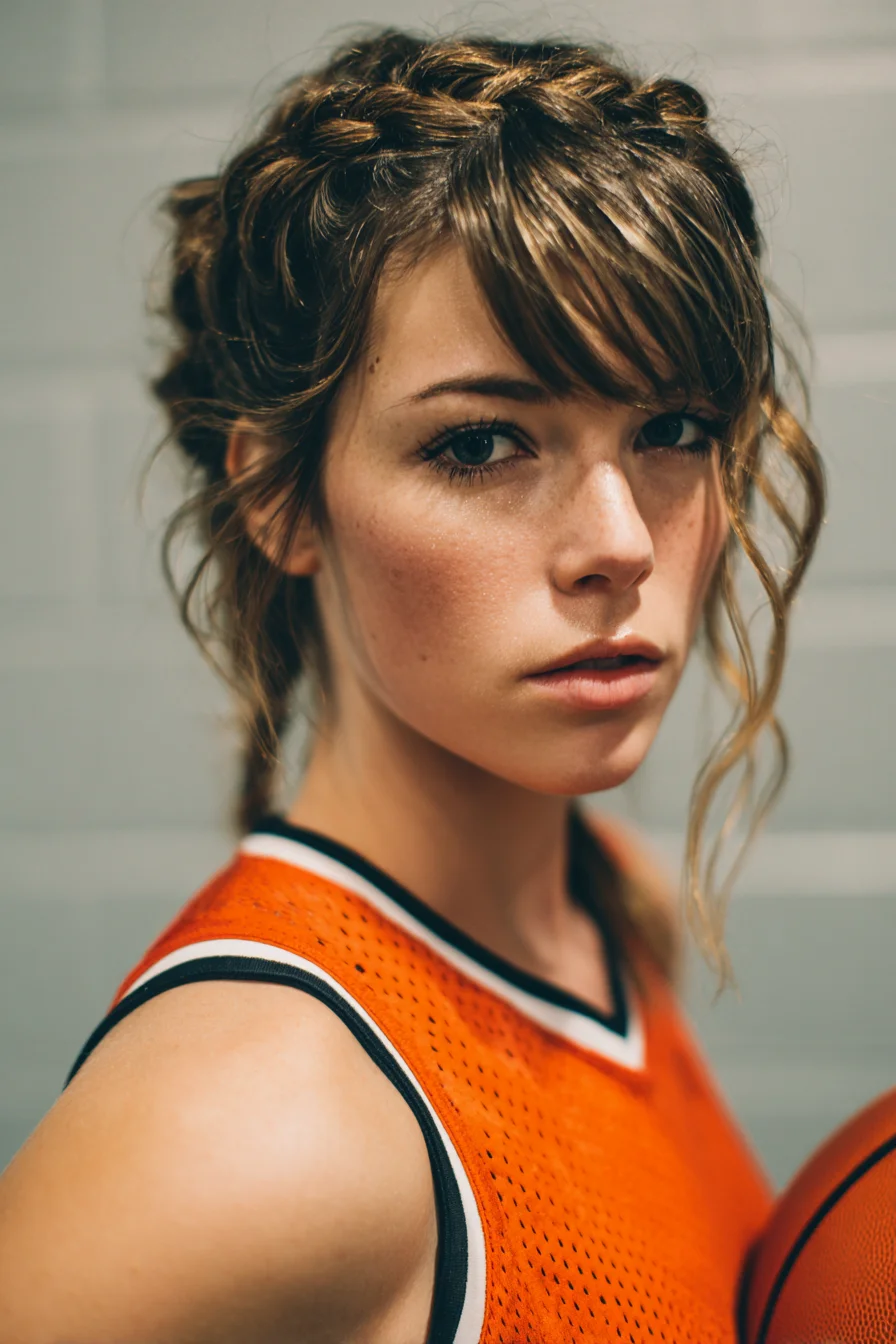
This textured crown braid with wispy face-framing waves suits medium to thick hair and straight to wavy textures—fine hair will benefit from pre-teasing or volumizing products, and curlier hair can be smoothed slightly for the braid. Start by sectioning a deep side part, create a loose Dutch or French braid along the hairline toward the crown, secure into a low messy bun or braid at the nape, and pull small pieces from the braid to soften and widen the crown. Use a 25mm curling iron to add soft waves to face-framing pieces. Tools: tail comb, sectioning clips, elastic bands, bobby pins, 25mm curling iron, and paddle brush. Products: heat protectant, texturizing or sea-salt spray, light-hold hairspray, and volumizing powder or dry shampoo for grip. Difficulty: moderate; requires basic braiding and pinning skills; allow 20–35 minutes. Maintenance: sleep on a silk pillowcase, refresh texture with dry shampoo and a little texturizer, retwist or repin loosened sections, and touch up bangs or face-frames with a quick curl. Trim ends and bangs every 6–10 weeks to keep shape.
Sleek Cornrows into Two Long Braids with Laid Edges
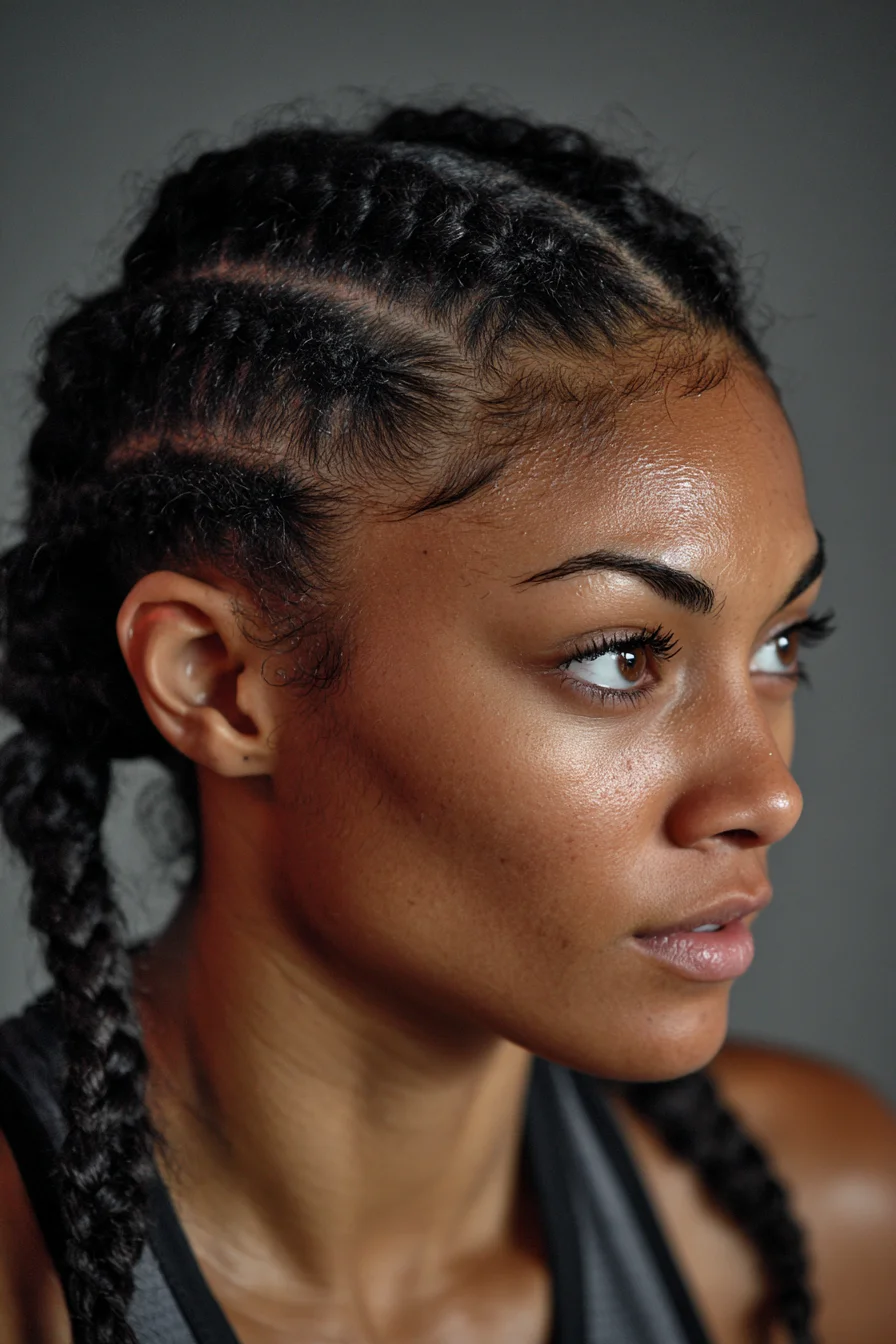
This polished cornrow style transitions into two long braids and is ideal for Type 3–4 textured hair, though it can be adapted for straight hair when a bit of texture is added. Technique: section the hair with a rat-tail comb into clean, even parts; apply a lightweight leave-in and a small amount of gel or edge control at the roots; feed the hair into tight three-strand cornrows close to the scalp and finish each side into a standard braid down the length. Tools needed: rat-tail comb, sectioning clips, edge brush, wide-tooth comb, elastic bands, spray bottle with water, and small clips. Products required: moisturizing leave-in conditioner, medium-hold braid gel or pomade, light oil or scalp serum, and a satin/silk scarf or bonnet. Difficulty level: intermediate — requires neat parting and steady braiding hands; expect 45–90 minutes depending on thickness and length. Maintenance tips: wrap nightly with a silk scarf, lightly oil the scalp twice weekly, avoid over-tightening to protect the hairline, refresh edges with minimal product as needed, and cleanse the scalp gently with diluted shampoo or co-wash every 1–2 weeks to prevent buildup.
Textured Dutch Braids with Loose Beachy Waves
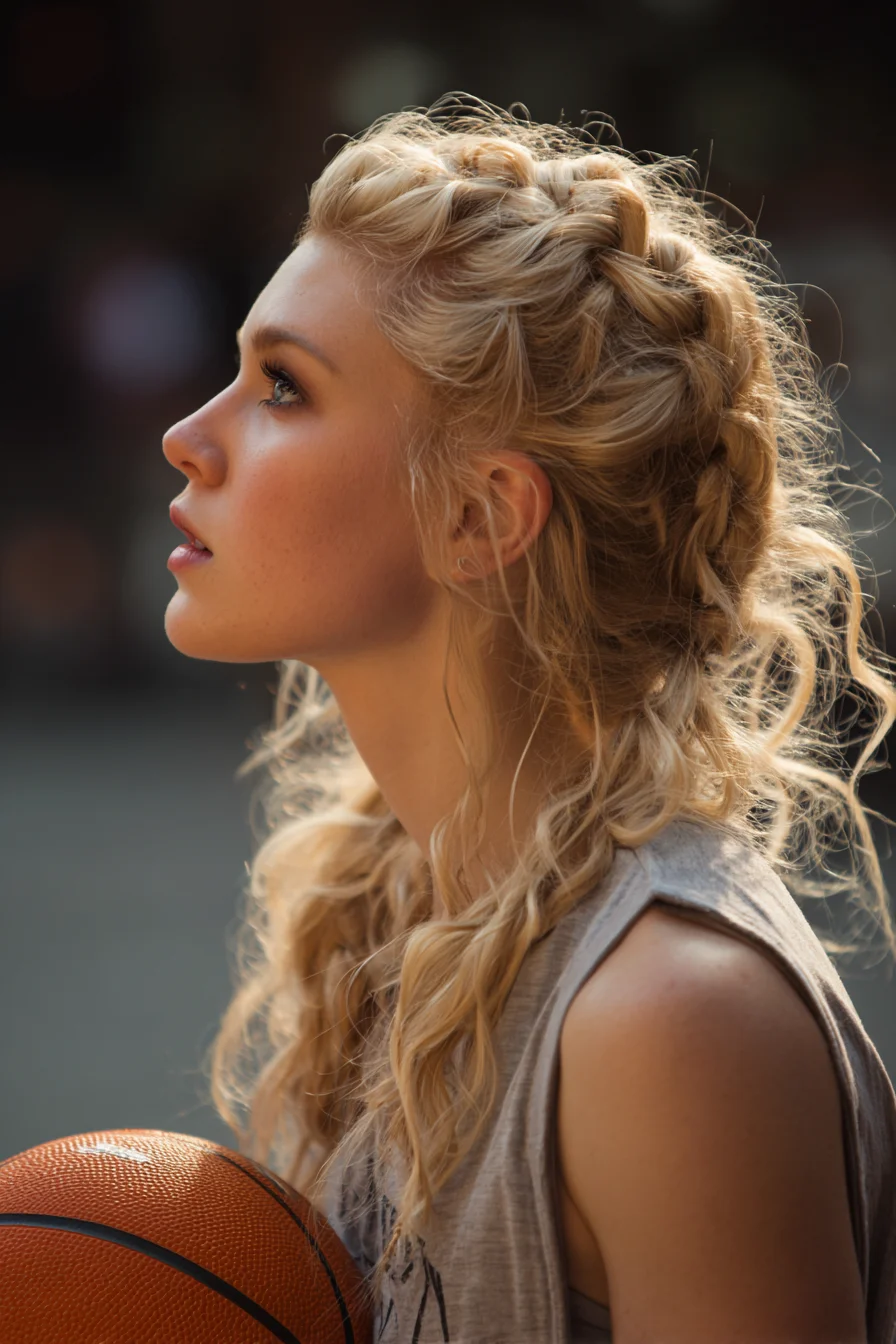
This look works best on medium-to-long hair and suits straight, wavy or naturally curly textures — fine hair will benefit from texturizing products and light teasing for body, while very thick hair may require sectioning and extra pins. Technique: prep hair with a salt spray or dry shampoo for grip, then create two Dutch (inside-out) braids from the hairline toward the crown, securing them with small elastics. Pancake the braid loops to widen and soften the shape, then release the remaining lengths and shape loose beachy waves with a 1–1.25 curling wand or a flat iron. Gently pull face-framing pieces forward for a lived-in finish. Tools needed: tail comb, sectioning clips, small clear elastics, bobby pins, curling wand, paddle brush. Products required: heat protectant, texturizing or sea-salt spray, light-hold hairspray, lightweight finishing oil or serum. Difficulty level: intermediate — basic braiding and curling skills required; allow 30–45 minutes. Maintenance tips: sleep with a silk scarf or loose braid, refresh waves with a spritz of texturizer or water, re-pancake or tighten braids on day two, and avoid heavy conditioners at the roots to maintain grip.
Dutch Braids into High Braided Ponytail — Textured Sporty Updo
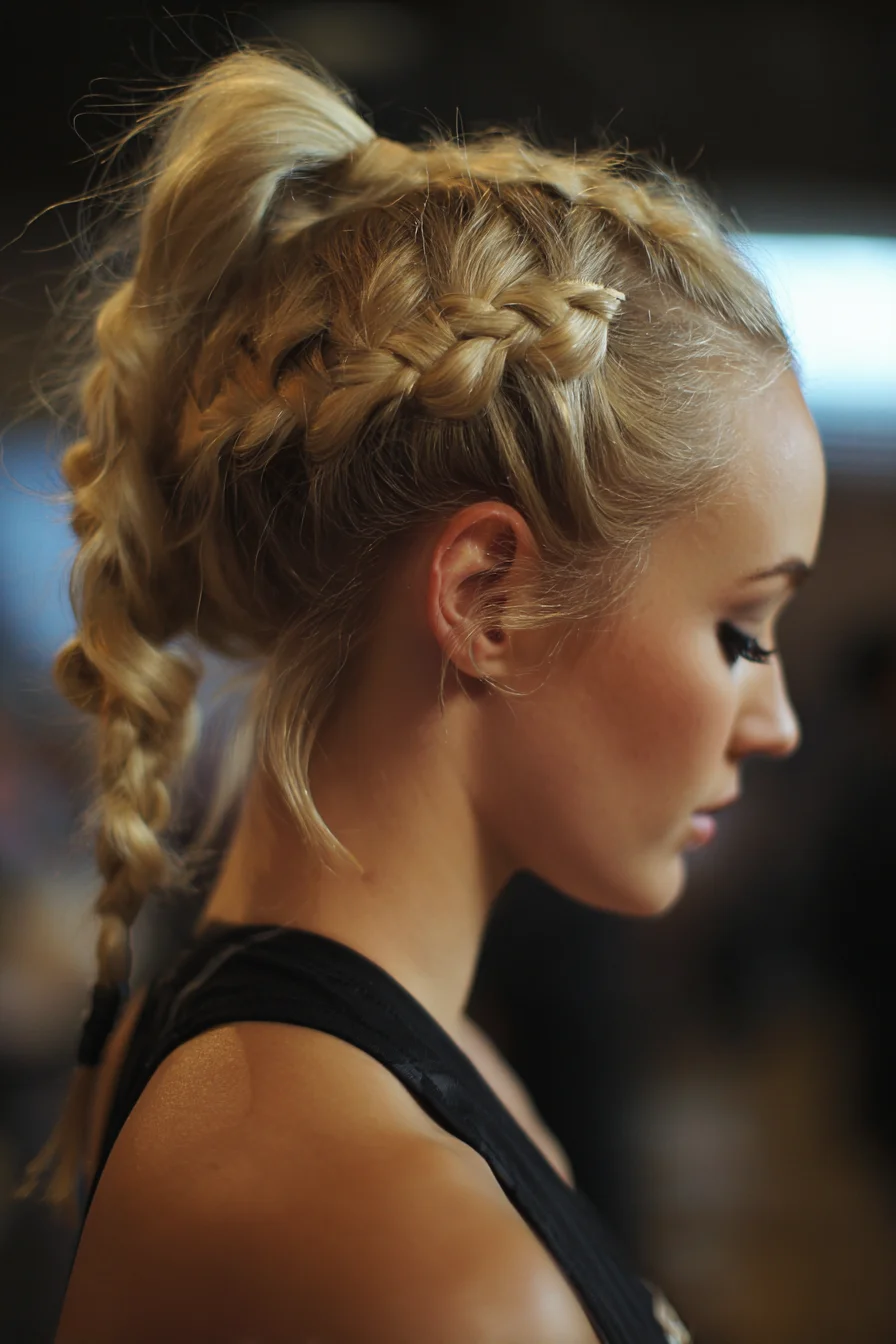
This look suits medium to long hair and works well on straight, slightly wavy, or thick textures; fine hair benefits from a texturizing product or light padding for grip. Start on dry hair: mist with dry shampoo or texturizing spray for hold, then create two Dutch braids (inverted French) along the hairline or just one on each side, feeding them back into a high pony at the crown. Secure with a strong elastic and continue with a regular three‑strand braid down the tail. Gently pancake the braid for width and pull small pieces at the crown for lift. Tools: tail comb, sectioning clips, small clear elastics, bobby pins, paddle brush. Products: dry shampoo or texturizing spray, light-hold mousse or styling cream for flyaways, anti-frizz serum, finishing hairspray and optional shine mist. Difficulty: intermediate — requires confident braiding and sectioning. Maintenance: refresh grip with dry shampoo, re-tighten the elastic or re-braid loose tails, smooth flyaways with a dab of serum, and sleep with a silk scarf to preserve shape. Replace elastics after 24–48 hours to avoid slippage.
Textured Dutch Braid into Twisted Low Bun — Braided Updo for Medium–Thick Hair
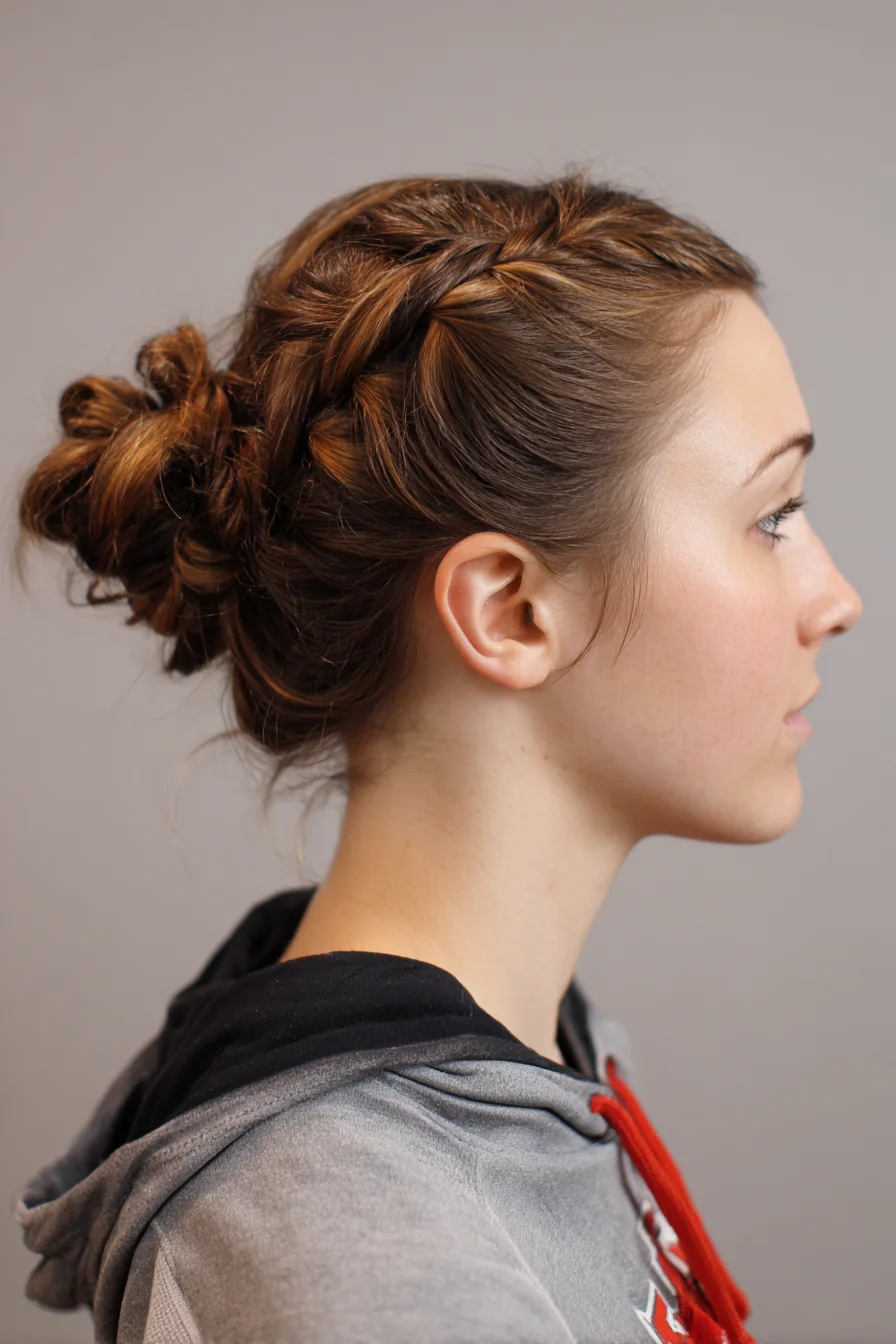
A textured Dutch braid swept into a twisted low bun creates a polished yet relaxed braided updo ideal for medium to thick hair and shoulder‑to‑long lengths. Technique: start on second‑day hair for better grip. Create a Dutch (inverted) braid along the crown or hairline, pulling slightly at each stitch to broaden the braid for a soft, voluminous look. Gather remaining hair at the nape, twist into a loose bun and secure with pins, tucking braid ends into the base. Tools needed: fine tail comb for parting, wide‑tooth comb, small clear elastics, a selection of bobby pins and U‑pins, sectioning clips, and a blow dryer if prepping. Products required: texturizing spray or dry shampoo for grip, light styling cream or serum for flyaways, and a flexible‑hold hairspray to set. Difficulty level: moderate — about 20–35 minutes; practice the Dutch braid technique beforehand. Maintenance tips: sleep on a silk pillowcase or use a loose scarf to protect shape; refresh with dry shampoo and re‑pin any loosened pieces; avoid heavy oils that weigh braid down. Ideal for events or everyday wear with simple touch‑ups.
Double Dutch Braids to Messy Top Knot — Braided Crown for Medium–Long Hair
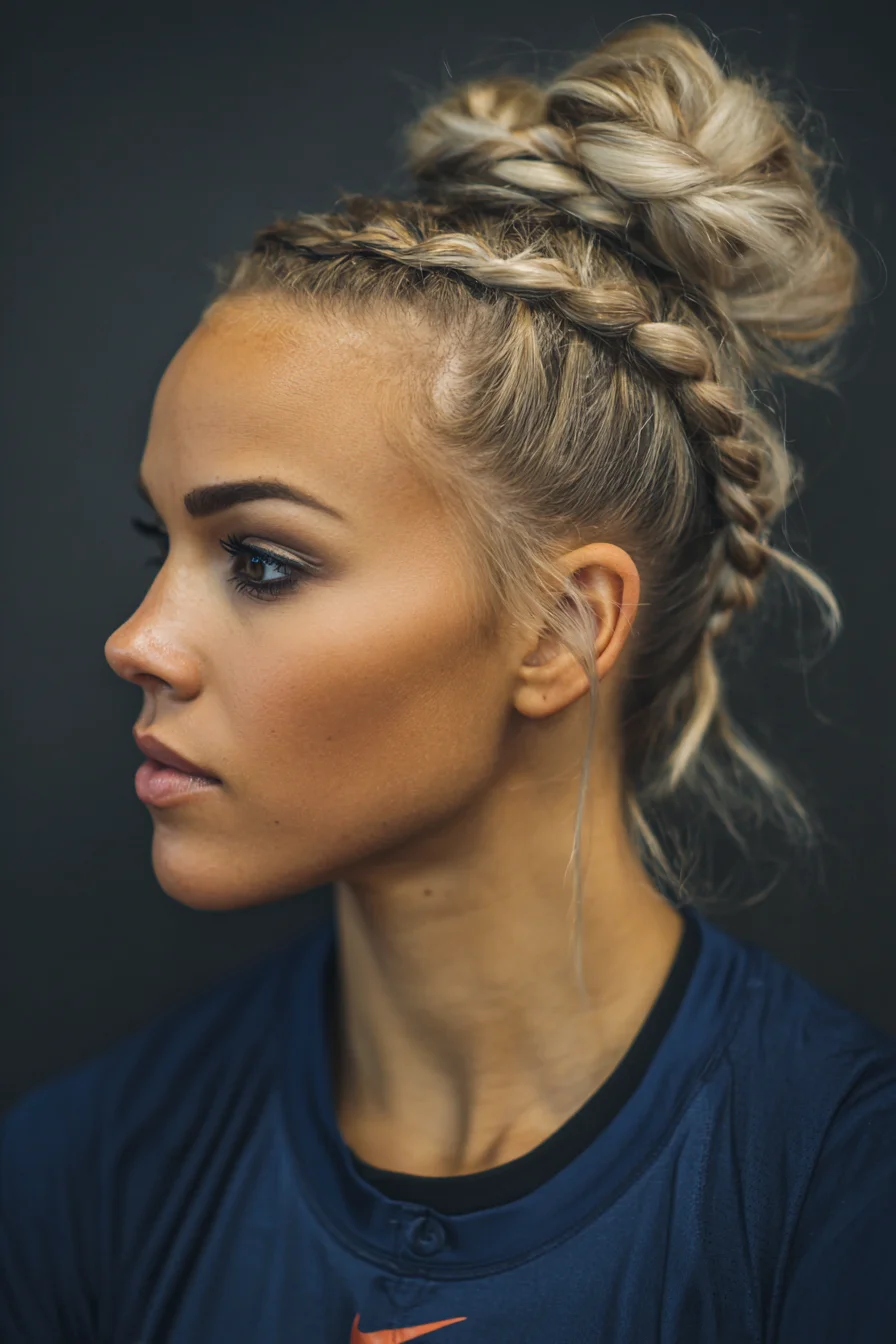
This look works best on medium to long hair and suits straight, wavy or loose-curly textures. Thick hair holds the shape naturally; fine hair benefits from texturizing spray or lightweight extensions for added volume. Start by parting and creating two Dutch (inside-out) braids from the hairline toward the crown, pancake the braids slightly for width, then secure both tails and gather hair into a high, messy bun, pulling pieces out for softness and a relaxed finish. Tools needed: rat-tail comb, sectioning clips, small clear elastics, bobby pins, brush, and optional curling iron to add pre-texture. Products required: texturizing or sea-salt spray, dry shampoo, lightweight pomade or edge control for baby hairs, flexible-hold hairspray and a shine serum. Difficulty: intermediate — requires confident braiding and clean parting; allow 20–40 minutes depending on practice. Maintenance tips: sleep on a silk pillow or wrap in a scarf, refresh grip with dry shampoo and re-pin any loose sections the next day, avoid over-tightening to protect edges, and use a tiny amount of oil on ends only to prevent dryness without weighing the style down.
Tousled Double Boxer Braids for Wavy & Curly Hair
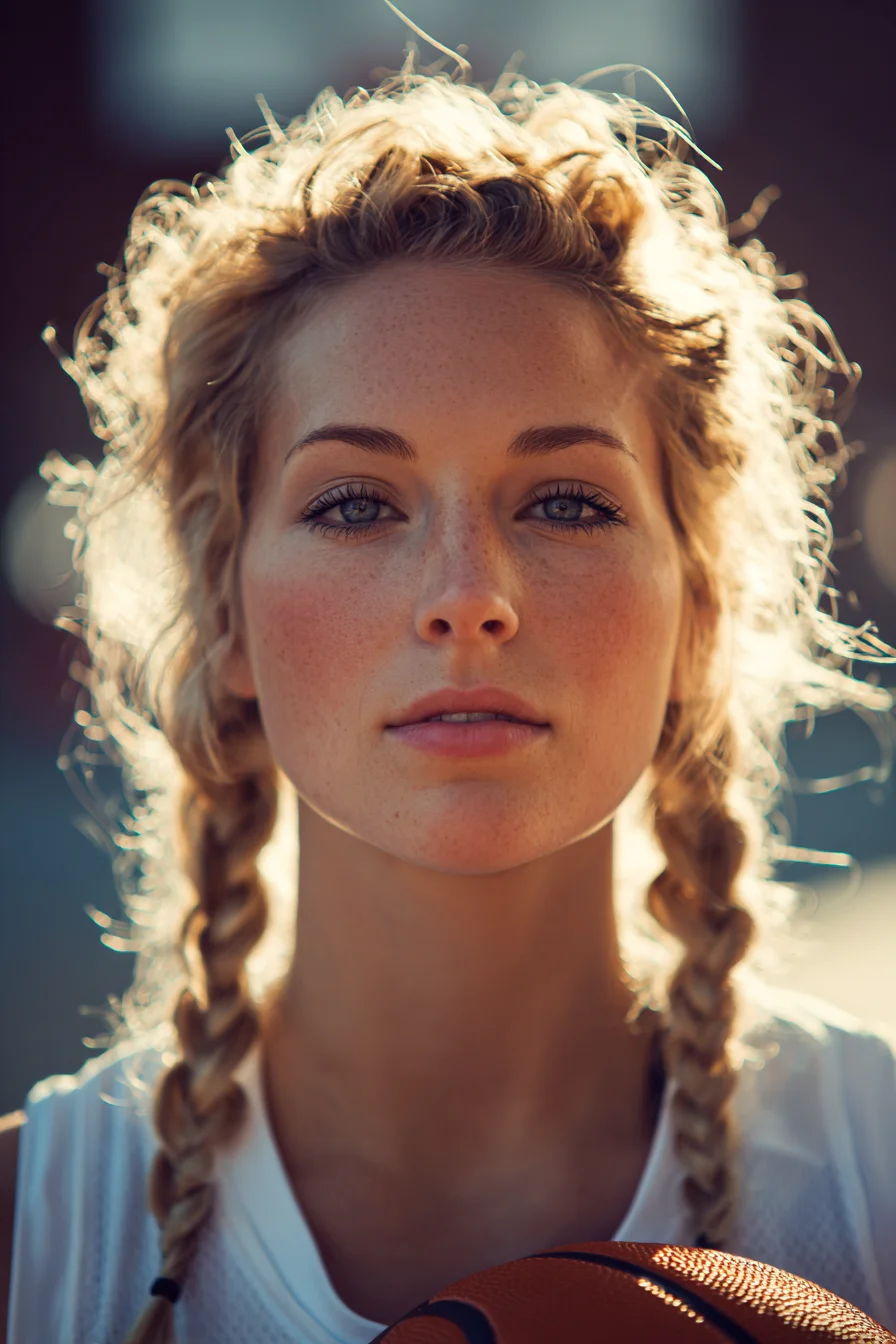
This tousled double boxer-braid look works best on wavy to curly textures and medium-to-thick hair; fine hair can achieve similar volume using a texturizing spray or clip-in extensions. Start on dry or second-day hair: create a precise center part with a tail comb, clip one side out of the way, then Dutch-braid (underhand) along the scalp from hairline to nape, adding small sections as you go. Secure ends with a small elastic and gently pancake each braid to widen and create relaxed, soft volume; pull a few face-framing pieces loose for that effortless finish. Tools: tail comb, sectioning clips, small elastics, boar-bristle brush and a wide-tooth comb. Products: sea-salt or texturizing spray, light mousse for hold, anti-frizz serum for ends, and a flexible-hold hairspray. Difficulty: intermediate — requires comfortable braiding technique; expect 15–30 minutes. Maintenance: refresh with dry shampoo and a mist of texturizer, re-pancake or retighten in the morning, sleep on silk and retie elastics loosely to protect strands. Remove braids gently to avoid breakage.
Textured Double Dutch Braids with Loose Ends
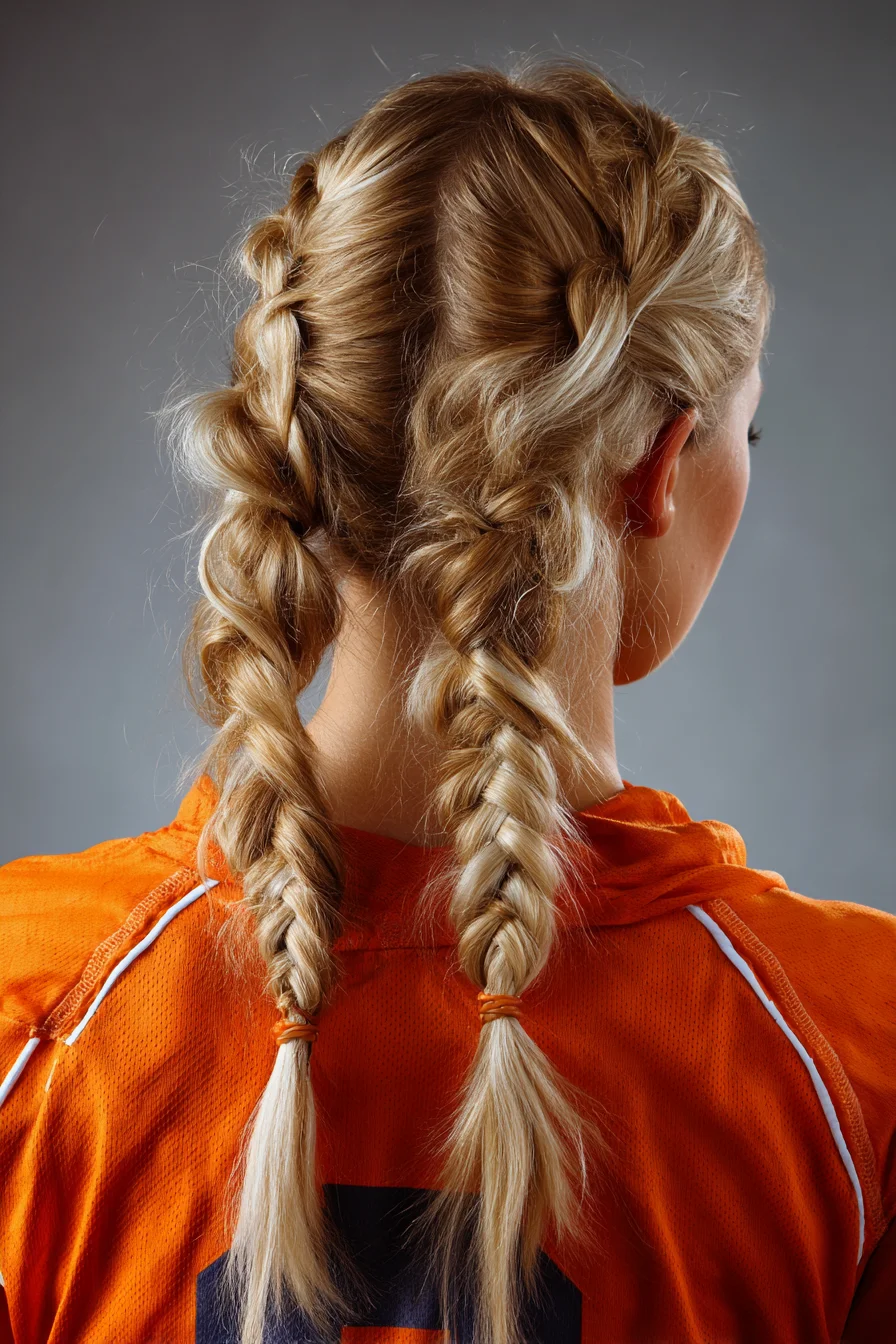
This sporty, salon-friendly style suits medium to long hair and works well on straight to wavy textures; curly hair can be smoothed slightly for neater braids. For fine hair use a texturizing spray or powder for grip; for thick or heavy hair, section carefully and work with smaller increments. Technique: create a clean center part, clip one side out of the way and Dutch-braid (underhand) from the hairline, adding hair as you go down to the nape; repeat on the other side. Finish each braid with a three-strand or fishtail to the ends, secure with elastics, then gently pancake (pull apart) sections for volume and softness. Tools needed: tail comb, sectioning clips, elastic bands, brush, and optional curling iron. Products recommended: leave-in detangler, texturizing spray or mousse, lightweight smoothing cream, and a flexible-hold hairspray. Difficulty: intermediate — expect 15–30 minutes. Maintenance tips: sleep on a silk pillow or wrap with a scarf, refresh with dry shampoo and light misting of hairspray, re-tighten elastics as needed, and deep-condition weekly to prevent end dryness.
As a stylist, I always prioritize hair health and practicality. These 24 basketball-ready styles prove you dont need to sacrifice care for convenience. For best results, prep hair with a light leave-in conditioner or detangling spray, secure with snag-free elastics, and use a small amount of gel or edge-control for clean hairlines. Alternate hairstyles across the week to avoid tension in the same spots — switch between low ponytails, braided updos, and soft buns. For curly or textured hair, stretch with banding or blow-dry on low heat for smoother styles, and always finish with a satin scarf or bonnet post-game to prevent friction. Keep a mini kit in your gym bag (elastics, bobby pins, travel hairspray, and a soft brush). If you want personalized tweaks — length-specific or texture-friendly variations — book a quick consult. I’m Lena, and in salon practice I’ve found these simple, strong looks keep you comfortable and confident on and off the court.